Daily Changing Russian Sentences. Beginner Russian. LLama
This deck is designed for Russian language learners who want to effectively acquire and understand Russian. It does so by showing different sentences every day consisting of the most frequently used words. This way you can build a good intuition for the meaning of the words and how the language actually works. This deck is great for self-study and a good supplement to formal education, 1-on-1 tutoring, speaking courses, and immersion based approaches like TPRS. No prior knowledge is necessary to use this deck. It will introduce letters and words 1-by-1 in a gradual fashion and with clear explanations.
Features:
- Learn words in context through sentences, not single words.
- Every day a different sentence for the same sentence-card
- Multiple English translations per sentence to get a 360 degree understanding of the sentences.
- 1 new word per card in context
- Introduces all the letters of the Russian alphabet.
- Clear and concise explanations.
- Inbuilt dictionary.
- Learn 250 words, including the top 100 most common words.
- Excellent audio with Yandex speech synthesis.
- Works for Desktop and Android (not iOS).
- Beautiful dark mode.
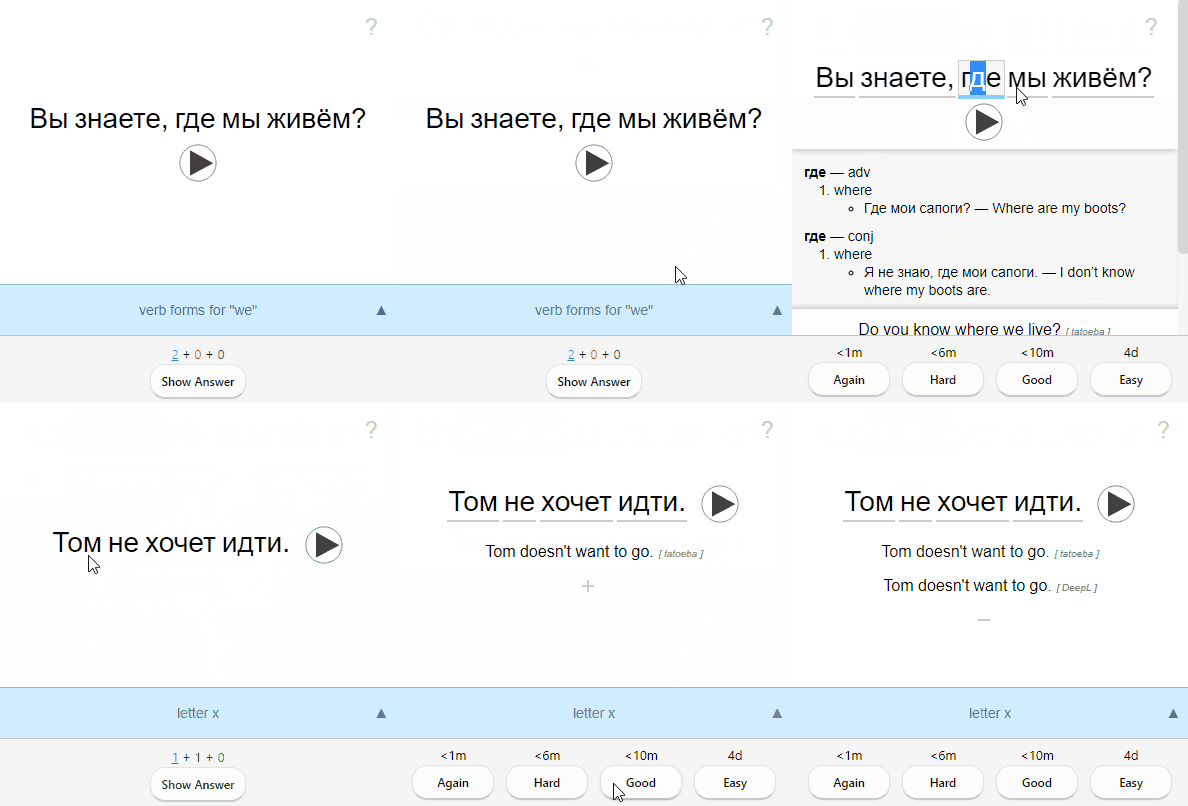
How to use Clearly, as this is not a default Anki deck, you should tweak the settings to accommodate for this different way of learning. See down below how you can do that. The cards themselves also have some nifty features to help you make sense of the sentences:
- Tap underlined words for a dictionary lookup
- Tap the "+" symbol for more translations
- Tap the blue bar at the bottom to get a clear explanation on a new grammar topic or on how to recognize the forms of words in a sentence
- There will be a Llama to help you out with newly introduced concepts. So keep an eye out for him.
- Whenever you are confused, tap the question mark in the top right to get help from the community
Setup
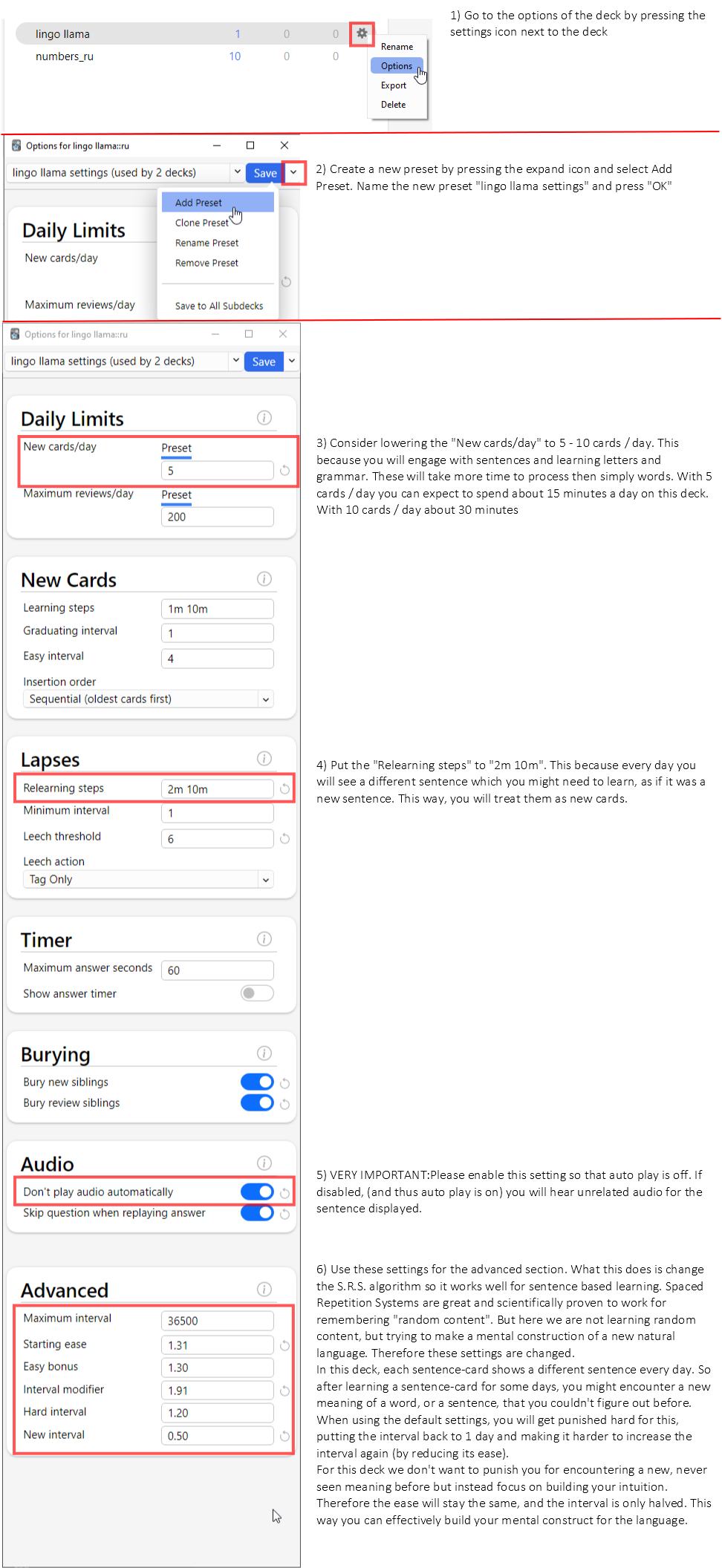
You have to disable "Auto play for Audio" for this deck to work properly. Also, as this is not a normal Anki Deck, it is highly recommended to change your settings as displayed down below:
If you find that your anki browser is slow, then please make sure that these 2 columns are disabled:

Issues / problems Known Issues:
- Android: The deck fully works for the Android app.
- Desktop: The deck fully works for the Anki desktop app
- iOS: iOS is not supported. Audio is working since 28 march 2024, but the main issue now is that you have to scroll down to see the llama and grammar descriptions.
- Web: Web is not supported. Main issue that you have to scroll down to see the llama and grammar descriptions.
If you like this deck and want to support the creator of the deck, then please consider to buy me a coffee!

Sample Data
| step | 124.0 |
| force | |
| llamafront | You can also creat the future with imperfective verbs. Read more about it down below. |
| llamaback | |
| infotype | grammar |
| infolabel | future tense with imperfective |
| infocontent | In Russian, both imperfective and perfective verbs can be used to create future tense, but they convey slightly different meanings.Imperfective future:To form the future tense with an imperfective verb, you'll use the verb "быть" (to be) in the future + the infinitive of the imperfective verb.Example: Я буду читать книгу. (I will be reading a book.) "буду" is the future form of "быть" and "читать" is the infinitive of the imperfective verb (to read).Difference between imperfective and perfective futureThe imperfective future is all about ongoing habitual or repeated actions in the future, while the perfective future focuses on the completion of a single action. Both are used to talk about the future, but they convey different nuances in meaning. |
| s1sid | 3626 |
| s1raw | Юми не будет играть в теннис. |
| s1dict | Юминене — particle (negative in full) not, no, -n't, without Он не знает — He does not know. не долетев до цели — without having reached the target он не гений — he is no genius Не делай этого! — Don’t do it! Не говори ни слова! — don’t say a word! Idiomatic negative usage (мне) не по себе ― (mne) ne po sebé ― (I) feel sick; (I) feel uncomfortable Я видел вас не раз. ― I have seen you often. тем не менее — nevertheless (partial negative) perhaps not, whether ... or not Счастье не счастье, но что-то похожее. — Perhaps not happiness, but something very much like it. Хочешь не хочешь, а придётся сделать. — like it or not, you’ll have to do it. will never (implying impossibility to do something) Ему этого не сделать. — He will never do it. не — intj (colloquial) no (used to show disagreement or negation) Поможешь мне? Не, даже и не думай. ― Will you help me? No, don't even think about it. не — prefix (usually not translated, gives affirmative meaning for expression, especially in exclamations), (With prepositions and pronouns не actually is a prefix, in spite of the fact that it is written separately.) Какой русский не любит быстрой езды! — What Russian doesn't like fast driving! Кто не любит поесть! — Who doesn't like a good meal! не с кем (né s kem, “from”) → некем (nékem) не из чего (né iz čevó, “from”) → нечего (néčevo) будетбудет from быть — verb impf 3-per sg fut to be Так было, так есть и так будет всегда! ― Tak býlo, tak jestʹ i tak búdet vsegdá!So it was, so it is, and so it will always be! [from the Hymn of the Russian Federation] быть под башмаком — to be henpecked игратьиграть — verb impf to play to act, to perform играть соло — to solo to gamble (of a storm) to rage (of wine) to sparkle вв — prep [+prepositional] (location) in, at, on Он в театре — He’s at (in) the theater. (direction) to, into Он идёт в театр — He’s going to (into) the theater. (time) at, in, on в три часа — at three o’clock в пятницу — on Friday per три раза в день — three times per day (indicating aim or purpose) for, as сказать в шутку — say as a joke в — noun m inan V, volt в — character The third letter of the Russian alphabet, called вэ and written in the Cyrillic script. теннис.теннис — noun m inan nom sg, acc sg (sports) tennis |
| s1trans | Yumi will not play tennis. [ tatoeba ] Yumi won't play tennis. [ DeepL ] |
| s1audio | |
| s2sid | 10277 |
| s2raw | Тебя я всегда буду любить. |
| s2dict | Тебятебя from ты — pron gen 2-per, acc 2-per you, thou (familiar, singular) яя — pron nom 1-per I, me Я русский ― I am Russian. я — character The thirty-third and final letter of the Russian Cyrillic alphabet. Its name is я (ja) and it has the sound of English ya in yard. It is preceded by the letter Ю (Ju). я — noun n inan The Cyrillic letter Я (Ja), я (ja). всегдавсегда — adv always будубуду from быть — verb impf 1-per sg fut to be Так было, так есть и так будет всегда! ― Tak býlo, tak jestʹ i tak búdet vsegdá!So it was, so it is, and so it will always be! [from the Hymn of the Russian Federation] быть под башмаком — to be henpecked буду — verb (colloquial) I will have, I would like Я буду водку ― I'll have vodka. любить.любить — verb impf to love, to like, to be fond of, to grow fond of (more intensely than нравиться (nrávitʹsja)) — Никто не скажет, будто я / Тиран и сумасброд, / За то, что к чаю я люблю / Хороший бутерброд. ― — Niktó ne skážet, búdto ja / Tirán i sumasbród, / Za tó, što k čáju ja ljubljú / Xoróšij butɛrbród/buterbród.“No one would say that I / Am a tyrant and madman, / For the fact that with my tea I like / A good bread-and-butter sandwich.” |
| s2trans | It's you I'll always love. [ tatoeba ] I will always love you. [ DeepL ] |
| s2audio | |
| s3sid | 10442 |
| s3raw | Я буду читать книгу. |
| s3dict | Яя — pron nom 1-per I, me Я русский ― I am Russian. Я — character The thirty-third and final letter of the Russian Cyrillic alphabet. Its name is Я (ja) and it has the sound of English ya in yard. It is preceded by the letter Ю. я — character The thirty-third and final letter of the Russian Cyrillic alphabet. Its name is я (ja) and it has the sound of English ya in yard. It is preceded by the letter Ю (Ju). я — noun n inan The Cyrillic letter Я (Ja), я (ja). будубуду from быть — verb impf 1-per sg fut to be Так было, так есть и так будет всегда! ― Tak býlo, tak jestʹ i tak búdet vsegdá!So it was, so it is, and so it will always be! [from the Hymn of the Russian Federation] быть под башмаком — to be henpecked буду — verb (colloquial) I will have, I would like Я буду водку ― I'll have vodka. читатьчитать — verb impf to read читать про себя — to read silently, to read to oneself читать между строк — to read between the lines читать без запинки — to read off, to run off читать запоем — to read avidly читать мысли — to read minds читать вслух — to read aloud не знает, а читать садится (saying) — learn to speak before you sing (literally, “he/she doesn’t know but to sit for reading”) не всё читай, иное пропускай (proverb) — do not read everything (aloud), skip some не много читай, да много разумей (proverb) — there is no need to read a lot, but to understand a lot to recite читать наизусть — to recite by heart (intransitive) to lecture, to give a lecture, to deliver a lecture читать лекции — to lecture to teach читать курс — to give a course (figuratively, transitive) to tell, to say (for the purpose of a lesson) читать нотации — to jaw читать мораль ― to moralize to pronounce, to deliver читать молитвы — to say one’s prayers читать проповедь — to preach читать рэп — to flow (figuratively) to understand, to interpret, to decipher читать чертежи — to interpret drawings читать карту — to read a map книгу.книгу from книга — noun f inan acc sg book Книги представляют собой нечто ценное, хотя и продаются по весьма дешёвым ценам, так что когда мне сказали: «деньги Вы можете оставлять незапертыми, но книги свои держите, пожалуйста, под замком», то я отнёсся к этому не просто как к шутке. ― Knígi predstavljájut sobój néčto cénnoje, xotjá i prodajútsja po vesʹmá dešóvym cénam, tak što kogdá mne skazáli: “dénʹgi Vy móžete ostavljátʹ nezápertymi, no knígi svoí deržíte, požálujsta, pod zamkóm”, to ja otnjóssja k étomu ne prósto kak k šútke.Although sold at very low prices, books are precious things, and I treated it as more than a joke when I was told that I could leave money lying about, but that my books should be kept under lock and key. |
| s3trans | I'll be reading a book. [ tatoeba ] I will read a book. [ tatoeba ] I'm going to read a book. [ tatoeba ] I will read the book. [ DeepL ] |
| s3audio | |
| s4sid | 16609 |
| s4raw | Я всегда буду любить тебя. |
| s4dict | Яя — pron nom 1-per I, me Я русский ― I am Russian. Я — character The thirty-third and final letter of the Russian Cyrillic alphabet. Its name is Я (ja) and it has the sound of English ya in yard. It is preceded by the letter Ю. я — character The thirty-third and final letter of the Russian Cyrillic alphabet. Its name is я (ja) and it has the sound of English ya in yard. It is preceded by the letter Ю (Ju). я — noun n inan The Cyrillic letter Я (Ja), я (ja). всегдавсегда — adv always будубуду from быть — verb impf 1-per sg fut to be Так было, так есть и так будет всегда! ― Tak býlo, tak jestʹ i tak búdet vsegdá!So it was, so it is, and so it will always be! [from the Hymn of the Russian Federation] быть под башмаком — to be henpecked буду — verb (colloquial) I will have, I would like Я буду водку ― I'll have vodka. любитьлюбить — verb impf to love, to like, to be fond of, to grow fond of (more intensely than нравиться (nrávitʹsja)) — Никто не скажет, будто я / Тиран и сумасброд, / За то, что к чаю я люблю / Хороший бутерброд. ― — Niktó ne skážet, búdto ja / Tirán i sumasbród, / Za tó, što k čáju ja ljubljú / Xoróšij butɛrbród/buterbród.“No one would say that I / Am a tyrant and madman, / For the fact that with my tea I like / A good bread-and-butter sandwich.” тебя.тебя from ты — pron gen 2-per, acc 2-per you, thou (familiar, singular) |
| s4trans | I will love you forever. [ tatoeba ] I'll always love you. [ tatoeba ] I will always love you. [ tatoeba ] I will always love you. [ DeepL ] |
| s4audio | |
| s5sid | 16621 |
| s5raw | Я буду всегда любить тебя. |
| s5dict | Яя — pron nom 1-per I, me Я русский ― I am Russian. Я — character The thirty-third and final letter of the Russian Cyrillic alphabet. Its name is Я (ja) and it has the sound of English ya in yard. It is preceded by the letter Ю. я — character The thirty-third and final letter of the Russian Cyrillic alphabet. Its name is я (ja) and it has the sound of English ya in yard. It is preceded by the letter Ю (Ju). я — noun n inan The Cyrillic letter Я (Ja), я (ja). будубуду from быть — verb impf 1-per sg fut to be Так было, так есть и так будет всегда! ― Tak býlo, tak jestʹ i tak búdet vsegdá!So it was, so it is, and so it will always be! [from the Hymn of the Russian Federation] быть под башмаком — to be henpecked буду — verb (colloquial) I will have, I would like Я буду водку ― I'll have vodka. всегдавсегда — adv always любитьлюбить — verb impf to love, to like, to be fond of, to grow fond of (more intensely than нравиться (nrávitʹsja)) — Никто не скажет, будто я / Тиран и сумасброд, / За то, что к чаю я люблю / Хороший бутерброд. ― — Niktó ne skážet, búdto ja / Tirán i sumasbród, / Za tó, što k čáju ja ljubljú / Xoróšij butɛrbród/buterbród.“No one would say that I / Am a tyrant and madman, / For the fact that with my tea I like / A good bread-and-butter sandwich.” тебя.тебя from ты — pron gen 2-per, acc 2-per you, thou (familiar, singular) |
| s5trans | I will always love you. [ tatoeba ] I will always love you. [ DeepL ] |
| s5audio | |
| s6sid | 19788 |
| s6raw | Думаешь, оно будет работать? |
| s6dict | Думаешь,думаешь from думать — verb impf 2-per sg pres to think to believe, to suppose онооно — pron n nom 3-per sg it (third-person neuter singular pronoun) будетбудет from быть — verb impf 3-per sg fut to be Так было, так есть и так будет всегда! ― Tak býlo, tak jestʹ i tak búdet vsegdá!So it was, so it is, and so it will always be! [from the Hymn of the Russian Federation] быть под башмаком — to be henpecked работать?работать — verb impf to work работать над чем-либо — to work on something (must be expressed with an instrumental case) работать на кого-либо — to work for someone (must be expressed with an accusative case) работать кем-либо — to work as [insert occupation or role] (must be expressed with an instrumental case) работать чем-либо — to work with [insert tool or device] (must be expressed with an instrumental case) to function to labor, to toil to be open (for business) |
| s6trans | You think that it will do work? [ tatoeba ] You think that it will work? [ tatoeba ] Do you think it will work? [ DeepL ] |
| s6audio | |
| s7sid | 16247 |
| s7raw | Сколько это будет стоить? |
| s7dict | Сколькосколько — pron nom sg, acc sg how much, how many Сколько это стоит? — How much does this cost? Сколько у вас книг? — How many books do you have? Сколько вам лет? — How old are you? Скольких лет он умер? — At what age did he die? so much, so many Сколько лет, сколько зим! — It’s been ages since we met! У скольких учителей я учился! — I’ve studied with so many teachers! how long Сколько мне ещё ждать? — How long do I still have to wait? сколько — adv how long, how much, so much as Я не столько устал, сколько голоден. — I’m not so much tired, as hungry. этоэто — intj uh, er, erm, umm; used in hesitant speech Я, это, не купил ничего — I, er, I haven't bought anything. это from этот — det m n nom, n acc proximal demonstrative adjective and pronoun, this будетбудет from быть — verb impf 3-per sg fut to be Так было, так есть и так будет всегда! ― Tak býlo, tak jestʹ i tak búdet vsegdá!So it was, so it is, and so it will always be! [from the Hymn of the Russian Federation] быть под башмаком — to be henpecked стоить?стоить — verb impf to cost Это стоит больших денег. — It costs a lot of money. to be worth to be worthy of, to deserve — Ты стоишь того, чтобы носить благоуханное имя, и нехорошо, что ты Маргарита, — но у людей нет для тебя имени. ― — Ty stóišʹ tovó, štóby nosítʹ blagouxánnoje ímja, i nexorošó, što ty Margaríta, — no u ljudéj net dlja tebjá ímeni."You deserve to bear a sweet-scented name; it is not good that you are Margarita, but among humans there is no name for you." it is sufficient (for some purpose), all you have to do is, one need only Ей чудилось, что вся квартира отъ полу до потолка занята громадным куском железа и что стоит только вынести вон железо, как всём станет весело и легко. ― Jej čúdilosʹ, što vsja kvartíra ot pólu do potolká zanjatá gromádnym kuskóm žéleza i što stóit tólʹko výnesti von želézo, kak vsjóm stánet véselo i lexkó.She had the feeling that the whole flat from floor to ceiling was occupied by an enormous lump of iron, and that if one could only carry away all the iron, everything would become cheerful and light. once (one thing happens another thing certainly happens) Ночи в сентябре холодные, а стоит только взойти солнцу, и холода как не бывало. ― Nóči v sentjabré xolódnyje, a stóit tólʹko vzojtí sólncu, i xóloda kak ne byválo.The nights in September are cold, but once the sun rises, it's as if the cold had never been. Политика — это лишь строительный материал новейшей истории, что-то вроде цемента. Стоит только встрять в неё — и всё! ― Polítika — éto lišʹ stroítelʹnyj materiál novéjšej istórii, štó-to vróde ceménta. Stóit tólʹko vstrjatʹ v nejó — i vsjó!Politics is only the building material of contemporary history, something like cement. Once you get stuck in it, you're finished! |
| s7trans | How much is this going to cost? [ tatoeba ] How much is that going to cost? [ tatoeba ] What will it all cost? [ tatoeba ] How much will this cost? [ tatoeba ] What'll it cost? [ tatoeba ] How much is it going to cost? [ tatoeba ] How much will it cost? [ tatoeba ] How much will that cost? [ tatoeba ] How much will it cost? [ DeepL ] |
| s7audio | |
| s8sid | 21736 |
| s8raw | Я буду ждать здесь, пока она не придёт. |
| s8dict | Яя — pron nom 1-per I, me Я русский ― I am Russian. Я — character The thirty-third and final letter of the Russian Cyrillic alphabet. Its name is Я (ja) and it has the sound of English ya in yard. It is preceded by the letter Ю. я — character The thirty-third and final letter of the Russian Cyrillic alphabet. Its name is я (ja) and it has the sound of English ya in yard. It is preceded by the letter Ю (Ju). я — noun n inan The Cyrillic letter Я (Ja), я (ja). будубуду from быть — verb impf 1-per sg fut to be Так было, так есть и так будет всегда! ― Tak býlo, tak jestʹ i tak búdet vsegdá!So it was, so it is, and so it will always be! [from the Hymn of the Russian Federation] быть под башмаком — to be henpecked буду — verb (colloquial) I will have, I would like Я буду водку ― I'll have vodka. ждатьждать — verb impf to wait, to wait for (+ genitive case) Решено Лолиту отправить туда же в ближайший четверг. Вместо того, чтобы ждать до июля, как было намечен сначала. ― Rešenó Lolitu otprávitʹ tudá že v bližájšij četvérg. Vmésto tovó, štóby ždatʹ do ijúlja, kak býlo naméčen snačála.Lolita, it was decided, would be sent there on Thursday instead of waiting until July, as was initially planned. to expect, to await здесь,здесь — adv here покапока — intj bye; so long; I’ll see you later; see you soon. пока — conj so long as, while Poká jestʹ gosudárstvo, net svobódy. Kogdá búdet svobóda, ne búdet gosudárstva. (Vladímir Lénin)While the State exists, there can be no freedom. When there is freedom there will be no State. — Vladimir Lenin пока — adv for the present, for the time being пока что — meanwhile, in the meantime я пока что это сделаю — I’ll do it in the meanwhile. for now (at the moment; until later) пока всё — that’s all; that will do Пока хватит, а завтра посмотрим ― Тhat's enough for now and let's see (again) tomorrow. онаона — pron f nom 3-per sg she, it Её нет дома (genitive) — She’s not home. Ей не спится. (dative) — She is unable to sleep. Я вижу её. (accusative) ― I see her. За нею пять рублей. (instrumental) — She owes five rubles. Он это при ней сказал. (prepositional) — He said it in her presence. нене — particle (negative in full) not, no, -n't, without Он не знает — He does not know. не долетев до цели — without having reached the target он не гений — he is no genius Не делай этого! — Don’t do it! Не говори ни слова! — don’t say a word! Idiomatic negative usage (мне) не по себе ― (mne) ne po sebé ― (I) feel sick; (I) feel uncomfortable Я видел вас не раз. ― I have seen you often. тем не менее — nevertheless (partial negative) perhaps not, whether ... or not Счастье не счастье, но что-то похожее. — Perhaps not happiness, but something very much like it. Хочешь не хочешь, а придётся сделать. — like it or not, you’ll have to do it. will never (implying impossibility to do something) Ему этого не сделать. — He will never do it. не — intj (colloquial) no (used to show disagreement or negation) Поможешь мне? Не, даже и не думай. ― Will you help me? No, don't even think about it. не — prefix (usually not translated, gives affirmative meaning for expression, especially in exclamations), (With prepositions and pronouns не actually is a prefix, in spite of the fact that it is written separately.) Какой русский не любит быстрой езды! — What Russian doesn't like fast driving! Кто не любит поесть! — Who doesn't like a good meal! не с кем (né s kem, “from”) → некем (nékem) не из чего (né iz čevó, “from”) → нечего (néčevo) придёт.придёт from прийти — verb pf 3-per sg fut to come (to), to arrive (at) |
| s8trans | I'll wait here until she comes. [ tatoeba ] I'll wait here until she gets here. [ DeepL ] |
| s8audio | |
| s9sid | 22328 |
| s9raw | Он будет ждать её. |
| s9dict | Онон — pron m nom 3-per sg he, it. будетбудет from быть — verb impf 3-per sg fut to be Так было, так есть и так будет всегда! ― Tak býlo, tak jestʹ i tak búdet vsegdá!So it was, so it is, and so it will always be! [from the Hymn of the Russian Federation] быть под башмаком — to be henpecked ждатьждать — verb impf to wait, to wait for (+ genitive case) Решено Лолиту отправить туда же в ближайший четверг. Вместо того, чтобы ждать до июля, как было намечен сначала. ― Rešenó Lolitu otprávitʹ tudá že v bližájšij četvérg. Vmésto tovó, štóby ždatʹ do ijúlja, kak býlo naméčen snačála.Lolita, it was decided, would be sent there on Thursday instead of waiting until July, as was initially planned. to expect, to await её.её from я — pron f gen 3-per sg, f acc 3-per sg I, me Я русский ― I am Russian. её — pron (possessive) her, its Где её книга? — Where is her book? Я уже видел её книгу. ― I have already seen her book. её from она — pron f gen 3-per sg, f acc 3-per sg she, it Её нет дома (genitive) — She’s not home. Ей не спится. (dative) — She is unable to sleep. Я вижу её. (accusative) ― I see her. За нею пять рублей. (instrumental) — She owes five rubles. Он это при ней сказал. (prepositional) — He said it in her presence. её from он — pron f gen 3-per sg, f acc 3-per sg he, it. её from мы — pron f gen 3-per sg, f acc 3-per sg we I (only when used with с (s)) мы с тобой — you and I мы с сестрой — me and my sister её from они — pron f gen 3-per sg, f acc 3-per sg (the third-person plural) they (the third-person singular, usually humorous or colloquial or dated) they её from оно — pron f gen 3-per sg, f acc 3-per sg it (third-person neuter singular pronoun) её from вы — pron f gen 3-per sg, f acc 3-per sg you (plural or formal) её from ты — pron f gen 3-per sg, f acc 3-per sg you, thou (familiar, singular) её from себя — pron f gen 3-per sg, f acc 3-per sg (reflexive pronoun) myself, yourself, himself, herself, itself, ourselves, yourselves, themselves (no nominative case) Он любит себя. — He loves himself. Я люблю себя. ― I love myself. Ему не по себе. — He feels out of sorts. Мне как-то не по себе. — I don’t feel quite myself. Она чувствует себя лучше. — She’s feeling better. Они у себя в комнате. — They're in their room. Мы знаем себя. — We know ourselves. Я поеду к себе. ― I will to go to my place. (reflexive pronoun) oneself |
| s9trans | He will be waiting for her. [ tatoeba ] He will wait for her. [ DeepL ] |
| s9audio | |
| s10sid | 23096 |
| s10raw | Он всегда будет любить её. |
| s10dict | Онон — pron m nom 3-per sg he, it. всегдавсегда — adv always будетбудет from быть — verb impf 3-per sg fut to be Так было, так есть и так будет всегда! ― Tak býlo, tak jestʹ i tak búdet vsegdá!So it was, so it is, and so it will always be! [from the Hymn of the Russian Federation] быть под башмаком — to be henpecked любитьлюбить — verb impf to love, to like, to be fond of, to grow fond of (more intensely than нравиться (nrávitʹsja)) — Никто не скажет, будто я / Тиран и сумасброд, / За то, что к чаю я люблю / Хороший бутерброд. ― — Niktó ne skážet, búdto ja / Tirán i sumasbród, / Za tó, što k čáju ja ljubljú / Xoróšij butɛrbród/buterbród.“No one would say that I / Am a tyrant and madman, / For the fact that with my tea I like / A good bread-and-butter sandwich.” её.её from я — pron f gen 3-per sg, f acc 3-per sg I, me Я русский ― I am Russian. её — pron (possessive) her, its Где её книга? — Where is her book? Я уже видел её книгу. ― I have already seen her book. её from она — pron f gen 3-per sg, f acc 3-per sg she, it Её нет дома (genitive) — She’s not home. Ей не спится. (dative) — She is unable to sleep. Я вижу её. (accusative) ― I see her. За нею пять рублей. (instrumental) — She owes five rubles. Он это при ней сказал. (prepositional) — He said it in her presence. её from он — pron f gen 3-per sg, f acc 3-per sg he, it. её from мы — pron f gen 3-per sg, f acc 3-per sg we I (only when used with с (s)) мы с тобой — you and I мы с сестрой — me and my sister её from они — pron f gen 3-per sg, f acc 3-per sg (the third-person plural) they (the third-person singular, usually humorous or colloquial or dated) they её from оно — pron f gen 3-per sg, f acc 3-per sg it (third-person neuter singular pronoun) её from вы — pron f gen 3-per sg, f acc 3-per sg you (plural or formal) её from ты — pron f gen 3-per sg, f acc 3-per sg you, thou (familiar, singular) её from себя — pron f gen 3-per sg, f acc 3-per sg (reflexive pronoun) myself, yourself, himself, herself, itself, ourselves, yourselves, themselves (no nominative case) Он любит себя. — He loves himself. Я люблю себя. ― I love myself. Ему не по себе. — He feels out of sorts. Мне как-то не по себе. — I don’t feel quite myself. Она чувствует себя лучше. — She’s feeling better. Они у себя в комнате. — They're in their room. Мы знаем себя. — We know ourselves. Я поеду к себе. ― I will to go to my place. (reflexive pronoun) oneself |
| s10trans | He will always love her. [ tatoeba ] He will love her forever. [ tatoeba ] He will always love her. [ DeepL ] |
| s10audio | |
| s11sid | 23908 |
| s11raw | Что ты будешь делать? |
| s11dict | Чточто — pron n nom sg, acc sg (interrogative) what Что это? — What is this? Он не знает, что это значит. ― He doesn’t know what this means. (literary, relative) that, which книга, что на столе — the book that is on the table что — conj that Я думаю, что он дома. ― I think that he's home. тыты — pron nom 2-per you, thou (familiar, singular) будешьбудешь from быть — verb impf 2-per sg fut to be Так было, так есть и так будет всегда! ― Tak býlo, tak jestʹ i tak búdet vsegdá!So it was, so it is, and so it will always be! [from the Hymn of the Russian Federation] быть под башмаком — to be henpecked делать?делать — verb impf to make, to do |
| s11trans | What'll you be doing? [ tatoeba ] What'll you do? [ tatoeba ] What will you do? [ tatoeba ] What are you going to do? [ DeepL ] |
| s11audio |
| step | 177.0 |
| force | |
| llamafront | |
| llamaback | |
| infotype | |
| infolabel | |
| infocontent | |
| s1sid | 830 |
| s1raw | Не помню твоего имени. |
| s1dict | Нене — particle (negative in full) not, no, -n't, without Он не знает — He does not know. не долетев до цели — without having reached the target он не гений — he is no genius Не делай этого! — Don’t do it! Не говори ни слова! — don’t say a word! Idiomatic negative usage (мне) не по себе ― (mne) ne po sebé ― (I) feel sick; (I) feel uncomfortable Я видел вас не раз. ― I have seen you often. тем не менее — nevertheless (partial negative) perhaps not, whether ... or not Счастье не счастье, но что-то похожее. — Perhaps not happiness, but something very much like it. Хочешь не хочешь, а придётся сделать. — like it or not, you’ll have to do it. will never (implying impossibility to do something) Ему этого не сделать. — He will never do it. не — intj (colloquial) no (used to show disagreement or negation) Поможешь мне? Не, даже и не думай. ― Will you help me? No, don't even think about it. не — prefix (usually not translated, gives affirmative meaning for expression, especially in exclamations), (With prepositions and pronouns не actually is a prefix, in spite of the fact that it is written separately.) Какой русский не любит быстрой езды! — What Russian doesn't like fast driving! Кто не любит поесть! — Who doesn't like a good meal! не с кем (né s kem, “from”) → некем (nékem) не из чего (né iz čevó, “from”) → нечего (néčevo) помнюпомню from помнить — verb impf 1-per sg pres to remember, to recollect, to think of, to keep in mind не помнить себя ― ne pómnitʹ sebjáto get carried away, to lose control of oneself помню from помнить — verb pf 1-per sg fut (dated or high-style) to think, to consider, to imagine твоеготвоего from твой — pron m+n gen, m acc (possessive) your, yours, thy, thine (2nd-person familiar, singular only) имени.имени from имя — noun n inan gen sg, dat sg, prep sg name, first name, Christian name, given name (for inanimate things, see название (nazvánije)) имя и отчество — first name and patronymic Завод имени Сталина — Stalin Automobile Plant имя при рождении — birth name (grammar) noun (broad sense) имя собственное ― appellative noun имя прилагательное ― adjective имя числительное ― numeral имени — adv named after (with genitive) (usually not translated, see имя (ímja)) Библиотека имени Ленина — The Lenin Library |
| s1trans | I don't remember your name. [ tatoeba ] I don't remember your name. [ DeepL ] |
| s1audio | |
| s2sid | 3653 |
| s2raw | То, что я не знаю её имя — это факт. |
| s2dict | То,то from тот — det m n nom, n acc that, those the one the other то — conj n then чточто — pron n nom sg, acc sg (interrogative) what Что это? — What is this? Он не знает, что это значит. ― He doesn’t know what this means. (literary, relative) that, which книга, что на столе — the book that is on the table что — conj that Я думаю, что он дома. ― I think that he's home. яя — pron nom 1-per I, me Я русский ― I am Russian. я — character The thirty-third and final letter of the Russian Cyrillic alphabet. Its name is я (ja) and it has the sound of English ya in yard. It is preceded by the letter Ю (Ju). я — noun n inan The Cyrillic letter Я (Ja), я (ja). нене — particle (negative in full) not, no, -n't, without Он не знает — He does not know. не долетев до цели — without having reached the target он не гений — he is no genius Не делай этого! — Don’t do it! Не говори ни слова! — don’t say a word! Idiomatic negative usage (мне) не по себе ― (mne) ne po sebé ― (I) feel sick; (I) feel uncomfortable Я видел вас не раз. ― I have seen you often. тем не менее — nevertheless (partial negative) perhaps not, whether ... or not Счастье не счастье, но что-то похожее. — Perhaps not happiness, but something very much like it. Хочешь не хочешь, а придётся сделать. — like it or not, you’ll have to do it. will never (implying impossibility to do something) Ему этого не сделать. — He will never do it. не — intj (colloquial) no (used to show disagreement or negation) Поможешь мне? Не, даже и не думай. ― Will you help me? No, don't even think about it. не — prefix (usually not translated, gives affirmative meaning for expression, especially in exclamations), (With prepositions and pronouns не actually is a prefix, in spite of the fact that it is written separately.) Какой русский не любит быстрой езды! — What Russian doesn't like fast driving! Кто не любит поесть! — Who doesn't like a good meal! не с кем (né s kem, “from”) → некем (nékem) не из чего (né iz čevó, “from”) → нечего (néčevo) знаюзнаю from знать — verb impf 1-per sg pres to know: to be familiar with or accustomed to a person, place, or thing Я её хорошо знаю. ― I know her well. Я хорошо знаю математику. ― I know math well. to know: to be in possession of a specific fact or datum Я знаю, где он живёт. ― I know where he lives. Я знаю, сколько два плюс два. — I know how much two plus two is. Я не знаю, когда это было. — I don’t know when it was. еёеё from я — pron f gen 3-per sg, f acc 3-per sg I, me Я русский ― I am Russian. её — pron (possessive) her, its Где её книга? — Where is her book? Я уже видел её книгу. ― I have already seen her book. её from она — pron f gen 3-per sg, f acc 3-per sg she, it Её нет дома (genitive) — She’s not home. Ей не спится. (dative) — She is unable to sleep. Я вижу её. (accusative) ― I see her. За нею пять рублей. (instrumental) — She owes five rubles. Он это при ней сказал. (prepositional) — He said it in her presence. её from он — pron f gen 3-per sg, f acc 3-per sg he, it. её from мы — pron f gen 3-per sg, f acc 3-per sg we I (only when used with с (s)) мы с тобой — you and I мы с сестрой — me and my sister её from они — pron f gen 3-per sg, f acc 3-per sg (the third-person plural) they (the third-person singular, usually humorous or colloquial or dated) they её from оно — pron f gen 3-per sg, f acc 3-per sg it (third-person neuter singular pronoun) её from вы — pron f gen 3-per sg, f acc 3-per sg you (plural or formal) её from ты — pron f gen 3-per sg, f acc 3-per sg you, thou (familiar, singular) её from себя — pron f gen 3-per sg, f acc 3-per sg (reflexive pronoun) myself, yourself, himself, herself, itself, ourselves, yourselves, themselves (no nominative case) Он любит себя. — He loves himself. Я люблю себя. ― I love myself. Ему не по себе. — He feels out of sorts. Мне как-то не по себе. — I don’t feel quite myself. Она чувствует себя лучше. — She’s feeling better. Они у себя в комнате. — They're in their room. Мы знаем себя. — We know ourselves. Я поеду к себе. ― I will to go to my place. (reflexive pronoun) oneself имяимя — noun n inan nom sg, acc sg name, first name, Christian name, given name (for inanimate things, see название (nazvánije)) имя и отчество — first name and patronymic Завод имени Сталина — Stalin Automobile Plant имя при рождении — birth name (grammar) noun (broad sense) имя собственное ― appellative noun имя прилагательное ― adjective имя числительное ― numeral ——— Indicates zero (omission) of the present tense of быть (bytʹ). Called тире (tirɛ́) in Russian. Время — деньги. ― Time is money. Alternative form of ( ). (encloses supplemental information) Replaces ‐ in some appositions, where hyphen would be used to connect the appositive word and the word in apposition if neither of them were a phrase. Некоторые государства — члены ЕС препятствуют размещению беженцев на своей территории. ― Some EU member states prevent placement of refugees on their territory. этоэто — intj uh, er, erm, umm; used in hesitant speech Я, это, не купил ничего — I, er, I haven't bought anything. это from этот — det m n nom, n acc proximal demonstrative adjective and pronoun, this факт.факт — noun m inan nom sg, acc sg fact fait accompli |
| s2trans | It is a fact that I don't know her name. [ tatoeba ] That I don't know her name is a fact. [ DeepL ] |
| s2audio | |
| s3sid | 6634 |
| s3raw | Я знаю его по имени. |
| s3dict | Яя — pron nom 1-per I, me Я русский ― I am Russian. Я — character The thirty-third and final letter of the Russian Cyrillic alphabet. Its name is Я (ja) and it has the sound of English ya in yard. It is preceded by the letter Ю. я — character The thirty-third and final letter of the Russian Cyrillic alphabet. Its name is я (ja) and it has the sound of English ya in yard. It is preceded by the letter Ю (Ju). я — noun n inan The Cyrillic letter Я (Ja), я (ja). знаюзнаю from знать — verb impf 1-per sg pres to know: to be familiar with or accustomed to a person, place, or thing Я её хорошо знаю. ― I know her well. Я хорошо знаю математику. ― I know math well. to know: to be in possession of a specific fact or datum Я знаю, где он живёт. ― I know where he lives. Я знаю, сколько два плюс два. — I know how much two plus two is. Я не знаю, когда это было. — I don’t know when it was. егоего from он — pron m+n gen 3-per sg, m+n acc 3-per sg he, it. его from оно — pron m+n gen 3-per sg, m+n acc 3-per sg it (third-person neuter singular pronoun) его — pron (possessive) his Где его книга? — Where is his book? Я уже видел его книгу. ― I already saw his book. (possessive) its попо — prep up to till indicates distribution (with numerals other than one, a thousand, a million, a billion, a trillion, etc. and compound numerals ending these words) по два (две) / по двести ― pó dva (dve) / po dvésti ― two / two hundred each along over around about on плыть по реке — to swim in a river according to showing the cause that is unwanting or unwilling (see из-за usage notes for more detail) indicates the direct object of some verbs of striking or hitting нанести удар по ядерным объектам Ирана — to launch a strike at Iran's nuclear ambitions indicates repetition of time по четвергам — on Thursdays (every Thursday) indicates distribution (with numerals one, a thousand, a million, a billion, a trillion, etc. and compound numerals ending in these words) по одному (одной) / по тысяче / по миллиону / по миллиарду ― po odnomú (odnój) / po týsjače / po milliónu / po milliárdu ― one / a thousand / a million / a billion each on, immediately after по приезде — on arrival for носить траур по нём — be in mourning for him to the liking of по нём — to his liking имени.имени from имя — noun n inan gen sg, dat sg, prep sg name, first name, Christian name, given name (for inanimate things, see название (nazvánije)) имя и отчество — first name and patronymic Завод имени Сталина — Stalin Automobile Plant имя при рождении — birth name (grammar) noun (broad sense) имя собственное ― appellative noun имя прилагательное ― adjective имя числительное ― numeral имени — adv named after (with genitive) (usually not translated, see имя (ímja)) Библиотека имени Ленина — The Lenin Library |
| s3trans | I know him by his first name. [ tatoeba ] I know him by name. [ DeepL ] |
| s3audio | |
| s4sid | 11430 |
| s4raw | Я знаю его имя. |
| s4dict | Яя — pron nom 1-per I, me Я русский ― I am Russian. Я — character The thirty-third and final letter of the Russian Cyrillic alphabet. Its name is Я (ja) and it has the sound of English ya in yard. It is preceded by the letter Ю. я — character The thirty-third and final letter of the Russian Cyrillic alphabet. Its name is я (ja) and it has the sound of English ya in yard. It is preceded by the letter Ю (Ju). я — noun n inan The Cyrillic letter Я (Ja), я (ja). знаюзнаю from знать — verb impf 1-per sg pres to know: to be familiar with or accustomed to a person, place, or thing Я её хорошо знаю. ― I know her well. Я хорошо знаю математику. ― I know math well. to know: to be in possession of a specific fact or datum Я знаю, где он живёт. ― I know where he lives. Я знаю, сколько два плюс два. — I know how much two plus two is. Я не знаю, когда это было. — I don’t know when it was. егоего from он — pron m+n gen 3-per sg, m+n acc 3-per sg he, it. его from оно — pron m+n gen 3-per sg, m+n acc 3-per sg it (third-person neuter singular pronoun) его — pron (possessive) his Где его книга? — Where is his book? Я уже видел его книгу. ― I already saw his book. (possessive) its имя.имя — noun n inan nom sg, acc sg name, first name, Christian name, given name (for inanimate things, see название (nazvánije)) имя и отчество — first name and patronymic Завод имени Сталина — Stalin Automobile Plant имя при рождении — birth name (grammar) noun (broad sense) имя собственное ― appellative noun имя прилагательное ― adjective имя числительное ― numeral |
| s4trans | I know his name. [ tatoeba ] I know his name. [ DeepL ] |
| s4audio | |
| s5sid | 14873 |
| s5raw | Я не помню его имени. |
| s5dict | Яя — pron nom 1-per I, me Я русский ― I am Russian. Я — character The thirty-third and final letter of the Russian Cyrillic alphabet. Its name is Я (ja) and it has the sound of English ya in yard. It is preceded by the letter Ю. я — character The thirty-third and final letter of the Russian Cyrillic alphabet. Its name is я (ja) and it has the sound of English ya in yard. It is preceded by the letter Ю (Ju). я — noun n inan The Cyrillic letter Я (Ja), я (ja). нене — particle (negative in full) not, no, -n't, without Он не знает — He does not know. не долетев до цели — without having reached the target он не гений — he is no genius Не делай этого! — Don’t do it! Не говори ни слова! — don’t say a word! Idiomatic negative usage (мне) не по себе ― (mne) ne po sebé ― (I) feel sick; (I) feel uncomfortable Я видел вас не раз. ― I have seen you often. тем не менее — nevertheless (partial negative) perhaps not, whether ... or not Счастье не счастье, но что-то похожее. — Perhaps not happiness, but something very much like it. Хочешь не хочешь, а придётся сделать. — like it or not, you’ll have to do it. will never (implying impossibility to do something) Ему этого не сделать. — He will never do it. не — intj (colloquial) no (used to show disagreement or negation) Поможешь мне? Не, даже и не думай. ― Will you help me? No, don't even think about it. не — prefix (usually not translated, gives affirmative meaning for expression, especially in exclamations), (With prepositions and pronouns не actually is a prefix, in spite of the fact that it is written separately.) Какой русский не любит быстрой езды! — What Russian doesn't like fast driving! Кто не любит поесть! — Who doesn't like a good meal! не с кем (né s kem, “from”) → некем (nékem) не из чего (né iz čevó, “from”) → нечего (néčevo) помнюпомню from помнить — verb impf 1-per sg pres to remember, to recollect, to think of, to keep in mind не помнить себя ― ne pómnitʹ sebjáto get carried away, to lose control of oneself помню from помнить — verb pf 1-per sg fut (dated or high-style) to think, to consider, to imagine егоего from он — pron m+n gen 3-per sg, m+n acc 3-per sg he, it. его from оно — pron m+n gen 3-per sg, m+n acc 3-per sg it (third-person neuter singular pronoun) его — pron (possessive) his Где его книга? — Where is his book? Я уже видел его книгу. ― I already saw his book. (possessive) its имени.имени from имя — noun n inan gen sg, dat sg, prep sg name, first name, Christian name, given name (for inanimate things, see название (nazvánije)) имя и отчество — first name and patronymic Завод имени Сталина — Stalin Automobile Plant имя при рождении — birth name (grammar) noun (broad sense) имя собственное ― appellative noun имя прилагательное ― adjective имя числительное ― numeral имени — adv named after (with genitive) (usually not translated, see имя (ímja)) Библиотека имени Ленина — The Lenin Library |
| s5trans | I don't remember his name. [ tatoeba ] I don't remember his name. [ DeepL ] |
| s5audio | |
| s6sid | 17932 |
| s6raw | "Ваше имя?" - "Робот". |
| s6dict | "Вашеваше from ваш — pron n nom, n acc (possessive) your, yours (2nd-person singular formal or 2nd-person plural) имя?"имя — noun n inan nom sg, acc sg name, first name, Christian name, given name (for inanimate things, see название (nazvánije)) имя и отчество — first name and patronymic Завод имени Сталина — Stalin Automobile Plant имя при рождении — birth name (grammar) noun (broad sense) имя собственное ― appellative noun имя прилагательное ― adjective имя числительное ― numeral -—— Indicates zero (omission) of the present tense of быть (bytʹ). Called тире (tirɛ́) in Russian. Время — деньги. ― Time is money. Alternative form of ( ). (encloses supplemental information) Replaces ‐ in some appositions, where hyphen would be used to connect the appositive word and the word in apposition if neither of them were a phrase. Некоторые государства — члены ЕС препятствуют размещению беженцев на своей территории. ― Some EU member states prevent placement of refugees on their territory. "Робот".робот — noun m anim nom sg robot (mechanical or virtual, artificial agent) я не робот — I am not a robot (captcha) (computing) bot |
| s6trans | Your name? - Robot. [ tatoeba ] "Your name?" - "Robot." [ DeepL ] |
| s6audio | |
| s7sid | 14922 |
| s7raw | Я знаю твоё имя. |
| s7dict | Яя — pron nom 1-per I, me Я русский ― I am Russian. Я — character The thirty-third and final letter of the Russian Cyrillic alphabet. Its name is Я (ja) and it has the sound of English ya in yard. It is preceded by the letter Ю. я — character The thirty-third and final letter of the Russian Cyrillic alphabet. Its name is я (ja) and it has the sound of English ya in yard. It is preceded by the letter Ю (Ju). я — noun n inan The Cyrillic letter Я (Ja), я (ja). знаюзнаю from знать — verb impf 1-per sg pres to know: to be familiar with or accustomed to a person, place, or thing Я её хорошо знаю. ― I know her well. Я хорошо знаю математику. ― I know math well. to know: to be in possession of a specific fact or datum Я знаю, где он живёт. ― I know where he lives. Я знаю, сколько два плюс два. — I know how much two plus two is. Я не знаю, когда это было. — I don’t know when it was. твоётвоё from твой — pron n nom, n acc (possessive) your, yours, thy, thine (2nd-person familiar, singular only) имя.имя — noun n inan nom sg, acc sg name, first name, Christian name, given name (for inanimate things, see название (nazvánije)) имя и отчество — first name and patronymic Завод имени Сталина — Stalin Automobile Plant имя при рождении — birth name (grammar) noun (broad sense) имя собственное ― appellative noun имя прилагательное ― adjective имя числительное ― numeral |
| s7trans | I know your first name. [ tatoeba ] I know your name. [ tatoeba ] I know your name. [ DeepL ] |
| s7audio | |
| s8sid | 24924 |
| s8raw | Я знаю ваше имя. |
| s8dict | Яя — pron nom 1-per I, me Я русский ― I am Russian. Я — character The thirty-third and final letter of the Russian Cyrillic alphabet. Its name is Я (ja) and it has the sound of English ya in yard. It is preceded by the letter Ю. я — character The thirty-third and final letter of the Russian Cyrillic alphabet. Its name is я (ja) and it has the sound of English ya in yard. It is preceded by the letter Ю (Ju). я — noun n inan The Cyrillic letter Я (Ja), я (ja). знаюзнаю from знать — verb impf 1-per sg pres to know: to be familiar with or accustomed to a person, place, or thing Я её хорошо знаю. ― I know her well. Я хорошо знаю математику. ― I know math well. to know: to be in possession of a specific fact or datum Я знаю, где он живёт. ― I know where he lives. Я знаю, сколько два плюс два. — I know how much two plus two is. Я не знаю, когда это было. — I don’t know when it was. вашеваше from ваш — pron n nom, n acc (possessive) your, yours (2nd-person singular formal or 2nd-person plural) имя.имя — noun n inan nom sg, acc sg name, first name, Christian name, given name (for inanimate things, see название (nazvánije)) имя и отчество — first name and patronymic Завод имени Сталина — Stalin Automobile Plant имя при рождении — birth name (grammar) noun (broad sense) имя собственное ― appellative noun имя прилагательное ― adjective имя числительное ― numeral |
| s8trans | I know your name. [ tatoeba ] I know your first name. [ tatoeba ] I know your name. [ DeepL ] |
| s8audio | |
| s9sid | 24897 |
| s9raw | Его имя знают все в этих местах. |
| s9dict | Егоего from он — pron m+n gen 3-per sg, m+n acc 3-per sg he, it. его from оно — pron m+n gen 3-per sg, m+n acc 3-per sg it (third-person neuter singular pronoun) его — pron (possessive) his Где его книга? — Where is his book? Я уже видел его книгу. ― I already saw his book. (possessive) its имяимя — noun n inan nom sg, acc sg name, first name, Christian name, given name (for inanimate things, see название (nazvánije)) имя и отчество — first name and patronymic Завод имени Сталина — Stalin Automobile Plant имя при рождении — birth name (grammar) noun (broad sense) имя собственное ― appellative noun имя прилагательное ― adjective имя числительное ― numeral знаютзнают from знать — verb impf 3-per pl pres to know: to be familiar with or accustomed to a person, place, or thing Я её хорошо знаю. ― I know her well. Я хорошо знаю математику. ― I know math well. to know: to be in possession of a specific fact or datum Я знаю, где он живёт. ― I know where he lives. Я знаю, сколько два плюс два. — I know how much two plus two is. Я не знаю, когда это было. — I don’t know when it was. всевсё from весь — pron n, n nom, n acc все from весь — pron pl, nom pl, acc pl all, the whole, the whole of весь день — all day; all day long весь грязный — dirty all over, all dirty весь в снегу — covered with snow всего — in all; altogether; sum total всего хорошего — all the best; good luck лучше всего — best of all во всём мире — all over the world изо всех сил — with all one’s might по всей стране — throughout the country при всём том — for all that everybody, everyone всё — adv (colloquial) always, all the time, constantly Он всё хотел вернуться домой — He kept wanting to return home. Я всё хотел тебя спросить... ― I've been wanting to ask you... (colloquial) still Он всё тот же. — He's still the same guy. всё больше и больше — more and more всё же — still, nevertheless, yet (colloquial) only, merely, specifically, namely Это всё ты виноват! — It's all your fault! (colloquial, predicative) that's it, done, enough Вот и всё! — That's it! вв — prep [+prepositional] (location) in, at, on Он в театре — He’s at (in) the theater. (direction) to, into Он идёт в театр — He’s going to (into) the theater. (time) at, in, on в три часа — at three o’clock в пятницу — on Friday per три раза в день — three times per day (indicating aim or purpose) for, as сказать в шутку — say as a joke в — noun m inan V, volt в — character The third letter of the Russian alphabet, called вэ and written in the Cyrillic script. этихэтих from этот — det m gen pl, acc pl, prep pl proximal demonstrative adjective and pronoun, this местах.местах from место — noun n inan prep pl place глухое место — backwoods задеть больное место — cut to the quick знать своё место — to know one’s place иметь место — to take place, to happen; to exist меняться местами — switch places на вашем месте — if I were you на местах — at the local level; in the provinces общее место — banality, platitude отхожее место — outhouse посадочное место — seat, seating place присутственное место — public office (in the Russian Empire) слабое место — weak spot тёплое место — gravy train, soft job (pl) region, area Вы бывали когда-либо в этих местах? ― Vy byváli kogdá-libo v étix mestáx?Have you ever been in these parts? site, scene место битвы — battle site job, position Я на этом месте проработал двадцать лет. ― Ja na étom méste prorabótal dvádcatʹ let.I’ve been at this job for twenty years. piece (of luggage) Сколько у Вас мест? ― Skólʹko u Vas mest?How many pieces of luggage do you have? room, space На ещё один сувенир в чемодане просто не хватило места. ― Na ješčó odín suvenír v čemodáne prósto ne xvatílo mesta.There was simply no room for another souvenir in the suitcase. |
| s9trans | His name is known to everybody in this area. [ tatoeba ] His name is known by everyone in these parts. [ DeepL ] |
| s9audio | |
| s10sid | 27081 |
| s10raw | Все знают его имя. |
| s10dict | Всевсё from весь — pron n, n nom, n acc все from весь — pron pl, nom pl, acc pl all, the whole, the whole of весь день — all day; all day long весь грязный — dirty all over, all dirty весь в снегу — covered with snow всего — in all; altogether; sum total всего хорошего — all the best; good luck лучше всего — best of all во всём мире — all over the world изо всех сил — with all one’s might по всей стране — throughout the country при всём том — for all that everybody, everyone всё — adv (colloquial) always, all the time, constantly Он всё хотел вернуться домой — He kept wanting to return home. Я всё хотел тебя спросить... ― I've been wanting to ask you... (colloquial) still Он всё тот же. — He's still the same guy. всё больше и больше — more and more всё же — still, nevertheless, yet (colloquial) only, merely, specifically, namely Это всё ты виноват! — It's all your fault! (colloquial, predicative) that's it, done, enough Вот и всё! — That's it! знаютзнают from знать — verb impf 3-per pl pres to know: to be familiar with or accustomed to a person, place, or thing Я её хорошо знаю. ― I know her well. Я хорошо знаю математику. ― I know math well. to know: to be in possession of a specific fact or datum Я знаю, где он живёт. ― I know where he lives. Я знаю, сколько два плюс два. — I know how much two plus two is. Я не знаю, когда это было. — I don’t know when it was. егоего from он — pron m+n gen 3-per sg, m+n acc 3-per sg he, it. его from оно — pron m+n gen 3-per sg, m+n acc 3-per sg it (third-person neuter singular pronoun) его — pron (possessive) his Где его книга? — Where is his book? Я уже видел его книгу. ― I already saw his book. (possessive) its имя.имя — noun n inan nom sg, acc sg name, first name, Christian name, given name (for inanimate things, see название (nazvánije)) имя и отчество — first name and patronymic Завод имени Сталина — Stalin Automobile Plant имя при рождении — birth name (grammar) noun (broad sense) имя собственное ― appellative noun имя прилагательное ― adjective имя числительное ― numeral |
| s10trans | Everybody knows his name. [ tatoeba ] Everyone knows his name. [ tatoeba ] Everyone knows his name. [ DeepL ] |
| s10audio | |
| s11sid | 26738 |
| s11raw | Я знаю его, но я не знаю его имени. |
| s11dict | Яя — pron nom 1-per I, me Я русский ― I am Russian. Я — character The thirty-third and final letter of the Russian Cyrillic alphabet. Its name is Я (ja) and it has the sound of English ya in yard. It is preceded by the letter Ю. я — character The thirty-third and final letter of the Russian Cyrillic alphabet. Its name is я (ja) and it has the sound of English ya in yard. It is preceded by the letter Ю (Ju). я — noun n inan The Cyrillic letter Я (Ja), я (ja). знаюзнаю from знать — verb impf 1-per sg pres to know: to be familiar with or accustomed to a person, place, or thing Я её хорошо знаю. ― I know her well. Я хорошо знаю математику. ― I know math well. to know: to be in possession of a specific fact or datum Я знаю, где он живёт. ― I know where he lives. Я знаю, сколько два плюс два. — I know how much two plus two is. Я не знаю, когда это было. — I don’t know when it was. его,его from он — pron m+n gen 3-per sg, m+n acc 3-per sg he, it. его from оно — pron m+n gen 3-per sg, m+n acc 3-per sg it (third-person neuter singular pronoun) его — pron (possessive) his Где его книга? — Where is his book? Я уже видел его книгу. ― I already saw his book. (possessive) its ноно — conj but, yet но — noun n inan but Есть маленькое «но» ― There is a slight objection. Никаких «но»! ― But me no buts! но — noun m inan Noh но — intj same as но-о-о (nó-o-o) яя — pron nom 1-per I, me Я русский ― I am Russian. я — character The thirty-third and final letter of the Russian Cyrillic alphabet. Its name is я (ja) and it has the sound of English ya in yard. It is preceded by the letter Ю (Ju). я — noun n inan The Cyrillic letter Я (Ja), я (ja). нене — particle (negative in full) not, no, -n't, without Он не знает — He does not know. не долетев до цели — without having reached the target он не гений — he is no genius Не делай этого! — Don’t do it! Не говори ни слова! — don’t say a word! Idiomatic negative usage (мне) не по себе ― (mne) ne po sebé ― (I) feel sick; (I) feel uncomfortable Я видел вас не раз. ― I have seen you often. тем не менее — nevertheless (partial negative) perhaps not, whether ... or not Счастье не счастье, но что-то похожее. — Perhaps not happiness, but something very much like it. Хочешь не хочешь, а придётся сделать. — like it or not, you’ll have to do it. will never (implying impossibility to do something) Ему этого не сделать. — He will never do it. не — intj (colloquial) no (used to show disagreement or negation) Поможешь мне? Не, даже и не думай. ― Will you help me? No, don't even think about it. не — prefix (usually not translated, gives affirmative meaning for expression, especially in exclamations), (With prepositions and pronouns не actually is a prefix, in spite of the fact that it is written separately.) Какой русский не любит быстрой езды! — What Russian doesn't like fast driving! Кто не любит поесть! — Who doesn't like a good meal! не с кем (né s kem, “from”) → некем (nékem) не из чего (né iz čevó, “from”) → нечего (néčevo) знаюзнаю from знать — verb impf 1-per sg pres to know: to be familiar with or accustomed to a person, place, or thing Я её хорошо знаю. ― I know her well. Я хорошо знаю математику. ― I know math well. to know: to be in possession of a specific fact or datum Я знаю, где он живёт. ― I know where he lives. Я знаю, сколько два плюс два. — I know how much two plus two is. Я не знаю, когда это было. — I don’t know when it was. егоего from он — pron m+n gen 3-per sg, m+n acc 3-per sg he, it. его from оно — pron m+n gen 3-per sg, m+n acc 3-per sg it (third-person neuter singular pronoun) его — pron (possessive) his Где его книга? — Where is his book? Я уже видел его книгу. ― I already saw his book. (possessive) its имени.имени from имя — noun n inan gen sg, dat sg, prep sg name, first name, Christian name, given name (for inanimate things, see название (nazvánije)) имя и отчество — first name and patronymic Завод имени Сталина — Stalin Automobile Plant имя при рождении — birth name (grammar) noun (broad sense) имя собственное ― appellative noun имя прилагательное ― adjective имя числительное ― numeral имени — adv named after (with genitive) (usually not translated, see имя (ímja)) Библиотека имени Ленина — The Lenin Library |
| s11trans | I know him, but I don't know his name. [ tatoeba ] I know him, but I don't know his name. [ DeepL ] |
| s11audio |
| step | 170.0 |
| force | |
| llamafront | |
| llamaback | |
| infotype | |
| infolabel | |
| infocontent | |
| s1sid | 2024 |
| s1raw | Я сам это видел. |
| s1dict | Яя — pron nom 1-per I, me Я русский ― I am Russian. Я — character The thirty-third and final letter of the Russian Cyrillic alphabet. Its name is Я (ja) and it has the sound of English ya in yard. It is preceded by the letter Ю. я — character The thirty-third and final letter of the Russian Cyrillic alphabet. Its name is я (ja) and it has the sound of English ya in yard. It is preceded by the letter Ю (Ju). я — noun n inan The Cyrillic letter Я (Ja), я (ja). самсам — pron m m nom, m acc (definitive pronoun, emphatic) self, -self Я сам это видел ― Ja sam éto vídelI saw it myself. Само государство так решило ― Samó gosudárstvo tak rešíloThe State itself has so decided. этоэто — intj uh, er, erm, umm; used in hesitant speech Я, это, не купил ничего — I, er, I haven't bought anything. это from этот — det m n nom, n acc proximal demonstrative adjective and pronoun, this видел.видел from видеть — verb impf m sg past to see (perceive by eyesight) Соединились наши орбиты. Мы видим мир, которого нет. ― Sojedinilisʹ naši orbity. My vidim mir, kotorovo net. to see (to be able to perceive by eyesight) Мы плохо видим в темноте. — We see poorly in the dark. to meet (someone) Я не видел вас целую неделю, я не слышал вас так долго. ― I haven't seen you for a week; I haven't heard you for so long. — Anton Chekhov, Ionich, 1898. to understand Он ясно видел, что власть его над людьми кончится навсегда, если только Христос не отречётся от своей проповеди. ― He saw clearly that his power over men would end forever unless Christ were to renounce his own message. — L. N. Tolstoy, The Destruction of Hell and Its Restoration, 1902. (computing) to detect the presence of a component После переустановки Windows комп перестал видеть видеокарту. — After reinstalling Windows, the computer no longer sees the video card. |
| s1trans | I myself saw it. [ tatoeba ] I've seen it myself. [ tatoeba ] I saw it myself. [ DeepL ] |
| s1audio | |
| s2sid | 6133 |
| s2raw | Ты сам мне так сказал. |
| s2dict | Тыты — pron nom 2-per you, thou (familiar, singular) самсам — pron m m nom, m acc (definitive pronoun, emphatic) self, -self Я сам это видел ― Ja sam éto vídelI saw it myself. Само государство так решило ― Samó gosudárstvo tak rešíloThe State itself has so decided. мнемне from я — pron dat 1-per, prep 1-per I, me Я русский ― I am Russian. тактак — adv so, thus так же — just as так и — and так как — since, because так и не — never like that so much Так плохо? — Is it that bad? just so then well yes так from така — noun f inan gen pl (numismatics) taka (currency of Bangladesh) сказал.сказал from сказать — verb pf m sg past to say, to tell Скажи, что я её люблю ― Без неё вся жизнь равна нулю ― Skaží, što ja jejó ljubljú ― Bez nejó vsja žiznʹ ravná nuljúTell her that I love her — Without her all life amounts to nothing |
| s2trans | You told me so yourself. [ tatoeba ] You told me so yourself. [ DeepL ] |
| s2audio | |
| s3sid | 6281 |
| s3raw | Он сам это сделал. |
| s3dict | Онон — pron m nom 3-per sg he, it. самсам — pron m m nom, m acc (definitive pronoun, emphatic) self, -self Я сам это видел ― Ja sam éto vídelI saw it myself. Само государство так решило ― Samó gosudárstvo tak rešíloThe State itself has so decided. этоэто — intj uh, er, erm, umm; used in hesitant speech Я, это, не купил ничего — I, er, I haven't bought anything. это from этот — det m n nom, n acc proximal demonstrative adjective and pronoun, this сделал.сделал from сделать — verb pf m sg past to make, to do сделать замечание — to pass a remark, to make a remark |
| s3trans | He himself did it. [ tatoeba ] He himself did that. [ tatoeba ] He did it himself. [ DeepL ] |
| s3audio | |
| s4sid | 7141 |
| s4raw | Я сам это знаю. |
| s4dict | Яя — pron nom 1-per I, me Я русский ― I am Russian. Я — character The thirty-third and final letter of the Russian Cyrillic alphabet. Its name is Я (ja) and it has the sound of English ya in yard. It is preceded by the letter Ю. я — character The thirty-third and final letter of the Russian Cyrillic alphabet. Its name is я (ja) and it has the sound of English ya in yard. It is preceded by the letter Ю (Ju). я — noun n inan The Cyrillic letter Я (Ja), я (ja). самсам — pron m m nom, m acc (definitive pronoun, emphatic) self, -self Я сам это видел ― Ja sam éto vídelI saw it myself. Само государство так решило ― Samó gosudárstvo tak rešíloThe State itself has so decided. этоэто — intj uh, er, erm, umm; used in hesitant speech Я, это, не купил ничего — I, er, I haven't bought anything. это from этот — det m n nom, n acc proximal demonstrative adjective and pronoun, this знаю.знаю from знать — verb impf 1-per sg pres to know: to be familiar with or accustomed to a person, place, or thing Я её хорошо знаю. ― I know her well. Я хорошо знаю математику. ― I know math well. to know: to be in possession of a specific fact or datum Я знаю, где он живёт. ― I know where he lives. Я знаю, сколько два плюс два. — I know how much two plus two is. Я не знаю, когда это было. — I don’t know when it was. |
| s4trans | I know it myself. [ tatoeba ] I know that myself. [ DeepL ] |
| s4audio | |
| s5sid | 12195 |
| s5raw | Я сам видел его. |
| s5dict | Яя — pron nom 1-per I, me Я русский ― I am Russian. Я — character The thirty-third and final letter of the Russian Cyrillic alphabet. Its name is Я (ja) and it has the sound of English ya in yard. It is preceded by the letter Ю. я — character The thirty-third and final letter of the Russian Cyrillic alphabet. Its name is я (ja) and it has the sound of English ya in yard. It is preceded by the letter Ю (Ju). я — noun n inan The Cyrillic letter Я (Ja), я (ja). самсам — pron m m nom, m acc (definitive pronoun, emphatic) self, -self Я сам это видел ― Ja sam éto vídelI saw it myself. Само государство так решило ― Samó gosudárstvo tak rešíloThe State itself has so decided. виделвидел from видеть — verb impf m sg past to see (perceive by eyesight) Соединились наши орбиты. Мы видим мир, которого нет. ― Sojedinilisʹ naši orbity. My vidim mir, kotorovo net. to see (to be able to perceive by eyesight) Мы плохо видим в темноте. — We see poorly in the dark. to meet (someone) Я не видел вас целую неделю, я не слышал вас так долго. ― I haven't seen you for a week; I haven't heard you for so long. — Anton Chekhov, Ionich, 1898. to understand Он ясно видел, что власть его над людьми кончится навсегда, если только Христос не отречётся от своей проповеди. ― He saw clearly that his power over men would end forever unless Christ were to renounce his own message. — L. N. Tolstoy, The Destruction of Hell and Its Restoration, 1902. (computing) to detect the presence of a component После переустановки Windows комп перестал видеть видеокарту. — After reinstalling Windows, the computer no longer sees the video card. его.его from он — pron m+n gen 3-per sg, m+n acc 3-per sg he, it. его from оно — pron m+n gen 3-per sg, m+n acc 3-per sg it (third-person neuter singular pronoun) его — pron (possessive) his Где его книга? — Where is his book? Я уже видел его книгу. ― I already saw his book. (possessive) its |
| s5trans | I saw him with my own eyes. [ tatoeba ] I saw it myself. [ DeepL ] |
| s5audio | |
| s6sid | 14926 |
| s6raw | Я сам это сделал. |
| s6dict | Яя — pron nom 1-per I, me Я русский ― I am Russian. Я — character The thirty-third and final letter of the Russian Cyrillic alphabet. Its name is Я (ja) and it has the sound of English ya in yard. It is preceded by the letter Ю. я — character The thirty-third and final letter of the Russian Cyrillic alphabet. Its name is я (ja) and it has the sound of English ya in yard. It is preceded by the letter Ю (Ju). я — noun n inan The Cyrillic letter Я (Ja), я (ja). самсам — pron m m nom, m acc (definitive pronoun, emphatic) self, -self Я сам это видел ― Ja sam éto vídelI saw it myself. Само государство так решило ― Samó gosudárstvo tak rešíloThe State itself has so decided. этоэто — intj uh, er, erm, umm; used in hesitant speech Я, это, не купил ничего — I, er, I haven't bought anything. это from этот — det m n nom, n acc proximal demonstrative adjective and pronoun, this сделал.сделал from сделать — verb pf m sg past to make, to do сделать замечание — to pass a remark, to make a remark |
| s6trans | I've done that myself. [ tatoeba ] I did it myself. [ tatoeba ] I made this myself. [ tatoeba ] I myself did it. [ tatoeba ] I made it myself. [ tatoeba ] I did it myself. [ DeepL ] |
| s6audio | |
| s7sid | 18801 |
| s7raw | Сами этого не знали. |
| s7dict | Самисами from сам — pron m pl, nom pl, acc pl (definitive pronoun, emphatic) self, -self Я сам это видел ― Ja sam éto vídelI saw it myself. Само государство так решило ― Samó gosudárstvo tak rešíloThe State itself has so decided. этогоэтого from этот — det m m+n gen, m acc proximal demonstrative adjective and pronoun, this нене — particle (negative in full) not, no, -n't, without Он не знает — He does not know. не долетев до цели — without having reached the target он не гений — he is no genius Не делай этого! — Don’t do it! Не говори ни слова! — don’t say a word! Idiomatic negative usage (мне) не по себе ― (mne) ne po sebé ― (I) feel sick; (I) feel uncomfortable Я видел вас не раз. ― I have seen you often. тем не менее — nevertheless (partial negative) perhaps not, whether ... or not Счастье не счастье, но что-то похожее. — Perhaps not happiness, but something very much like it. Хочешь не хочешь, а придётся сделать. — like it or not, you’ll have to do it. will never (implying impossibility to do something) Ему этого не сделать. — He will never do it. не — intj (colloquial) no (used to show disagreement or negation) Поможешь мне? Не, даже и не думай. ― Will you help me? No, don't even think about it. не — prefix (usually not translated, gives affirmative meaning for expression, especially in exclamations), (With prepositions and pronouns не actually is a prefix, in spite of the fact that it is written separately.) Какой русский не любит быстрой езды! — What Russian doesn't like fast driving! Кто не любит поесть! — Who doesn't like a good meal! не с кем (né s kem, “from”) → некем (nékem) не из чего (né iz čevó, “from”) → нечего (néčevo) знали.знали from знать — verb impf pl past to know: to be familiar with or accustomed to a person, place, or thing Я её хорошо знаю. ― I know her well. Я хорошо знаю математику. ― I know math well. to know: to be in possession of a specific fact or datum Я знаю, где он живёт. ― I know where he lives. Я знаю, сколько два плюс два. — I know how much two plus two is. Я не знаю, когда это было. — I don’t know when it was. |
| s7trans | You didn't know that either. [ tatoeba ] They didn't know it themselves. [ DeepL ] |
| s7audio | |
| s8sid | 21021 |
| s8raw | Я сделаю это сам. |
| s8dict | Яя — pron nom 1-per I, me Я русский ― I am Russian. Я — character The thirty-third and final letter of the Russian Cyrillic alphabet. Its name is Я (ja) and it has the sound of English ya in yard. It is preceded by the letter Ю. я — character The thirty-third and final letter of the Russian Cyrillic alphabet. Its name is я (ja) and it has the sound of English ya in yard. It is preceded by the letter Ю (Ju). я — noun n inan The Cyrillic letter Я (Ja), я (ja). сделаюсделаю from сделать — verb pf 1-per sg fut to make, to do сделать замечание — to pass a remark, to make a remark этоэто — intj uh, er, erm, umm; used in hesitant speech Я, это, не купил ничего — I, er, I haven't bought anything. это from этот — det m n nom, n acc proximal demonstrative adjective and pronoun, this сам.сам — pron m m nom, m acc (definitive pronoun, emphatic) self, -self Я сам это видел ― Ja sam éto vídelI saw it myself. Само государство так решило ― Samó gosudárstvo tak rešíloThe State itself has so decided. |
| s8trans | I'll do this myself. [ tatoeba ] I'll do it myself. [ tatoeba ] I will do it myself. [ tatoeba ] I'll do it myself. [ DeepL ] |
| s8audio | |
| s9sid | 21569 |
| s9raw | Я хочу сделать это сам. |
| s9dict | Яя — pron nom 1-per I, me Я русский ― I am Russian. Я — character The thirty-third and final letter of the Russian Cyrillic alphabet. Its name is Я (ja) and it has the sound of English ya in yard. It is preceded by the letter Ю. я — character The thirty-third and final letter of the Russian Cyrillic alphabet. Its name is я (ja) and it has the sound of English ya in yard. It is preceded by the letter Ю (Ju). я — noun n inan The Cyrillic letter Я (Ja), я (ja). хочухочу from хотеть — verb impf 1-per sg pres to want, to desire сделатьсделать — verb pf to make, to do сделать замечание — to pass a remark, to make a remark этоэто — intj uh, er, erm, umm; used in hesitant speech Я, это, не купил ничего — I, er, I haven't bought anything. это from этот — det m n nom, n acc proximal demonstrative adjective and pronoun, this сам.сам — pron m m nom, m acc (definitive pronoun, emphatic) self, -self Я сам это видел ― Ja sam éto vídelI saw it myself. Само государство так решило ― Samó gosudárstvo tak rešíloThe State itself has so decided. |
| s9trans | I want to do that myself. [ tatoeba ] I want to do this myself. [ tatoeba ] I want to do it myself. [ tatoeba ] I want to do that by myself. [ tatoeba ] I want to do it myself. [ DeepL ] |
| s9audio | |
| s10sid | 23448 |
| s10raw | Продолжай сам. |
| s10dict | Продолжайпродолжай from продолжать — verb impf sg imper to continue, to proceed (with), to go on to keep on сам.сам — pron m m nom, m acc (definitive pronoun, emphatic) self, -self Я сам это видел ― Ja sam éto vídelI saw it myself. Само государство так решило ― Samó gosudárstvo tak rešíloThe State itself has so decided. |
| s10trans | You go on alone. [ tatoeba ] Continue on your own. [ DeepL ] |
| s10audio | |
| s11sid | 24504 |
| s11raw | Том должен был пойти сам. |
| s11dict | ТомТом — name m anim nom sg, acc sg A male given name, Tom том from тот — det m m+n prep that, those the one the other том — noun m inan nom sg, acc sg volume (of a book, magazine or disk) должендолжен — adj short m obligated я должен платить — I have to/should pay (literally, “I am obligated to pay”) он должен мне пять тысяч рублей — he owes me five thousand rubles (literally, “he is obligated to me for five thousand rubles”) былбыл from быть — verb impf m sg past to be Так было, так есть и так будет всегда! ― Tak býlo, tak jestʹ i tak búdet vsegdá!So it was, so it is, and so it will always be! [from the Hymn of the Russian Federation] быть под башмаком — to be henpecked пойтипойти — verb pf to go Пойдите со мной. — Come with me. (polite) to walk to rain to function, to work сам.сам — pron m m nom, m acc (definitive pronoun, emphatic) self, -self Я сам это видел ― Ja sam éto vídelI saw it myself. Само государство так решило ― Samó gosudárstvo tak rešíloThe State itself has so decided. |
| s11trans | Tom had to go himself. [ tatoeba ] Tom had to go himself. [ DeepL ] |
| s11audio |