🇰🇷 7000 Korean Sentences with 🎧 Audio + 🧩 Breakdown
🇰🇷 7000 Korean Sentences with 🎧 Audio + 🧩 Breakdown
(Now with full Night Mode support for comfortable study anytime!)
This is a complete set of 7000 essential Korean sentences, designed to take you from beginner to advanced. Each sentence includes high-quality audio recordings to support pronunciation, listening, and speaking practice.
🔹 What's Included?
✅ Korean Sentence + Audio - Hear and repeat natural Korean pronunciation.
✅ Extremely Detailed Translations - Not just a basic translation!
✅ Sentence Breakdown - Understand how each part works.
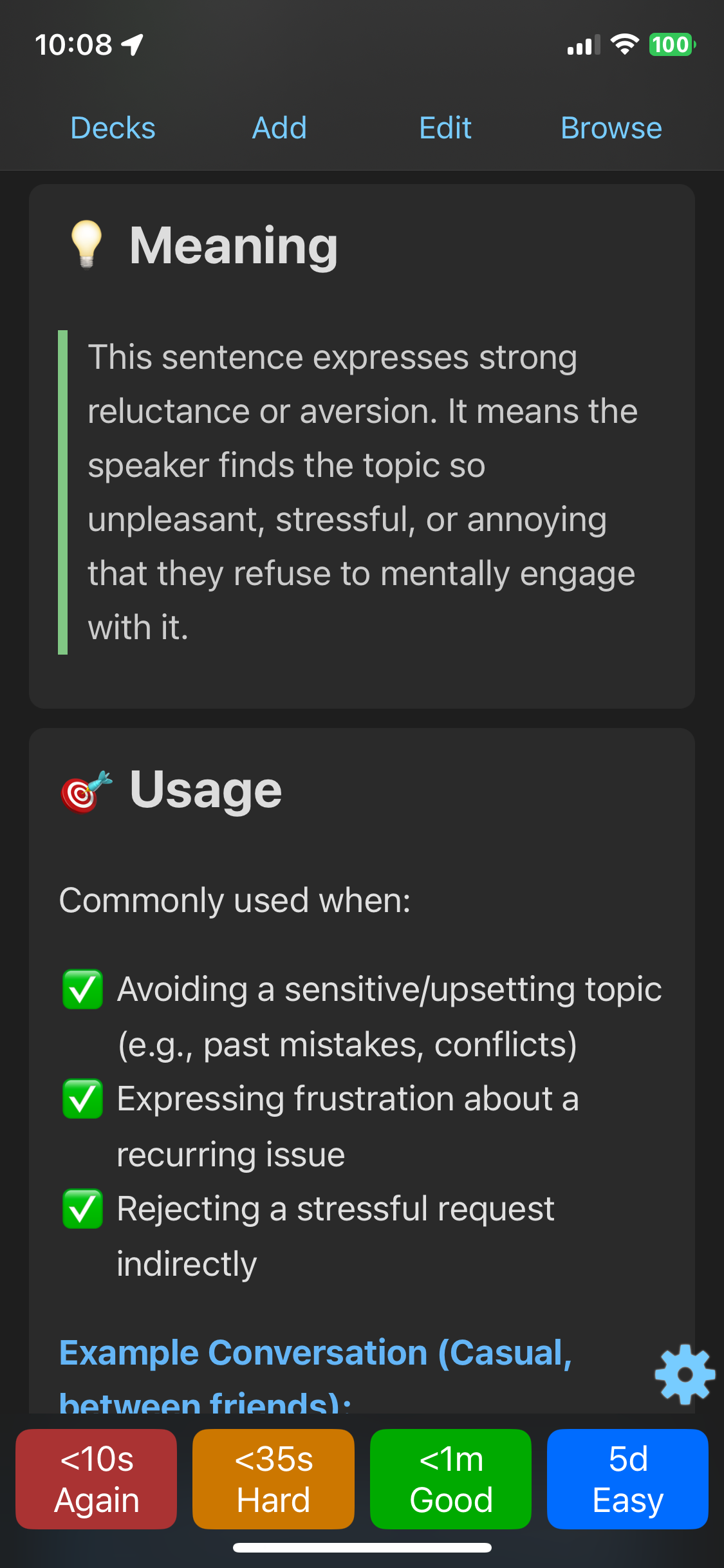
✅ Word Meanings & Usage - Learn when and how to use key phrases.
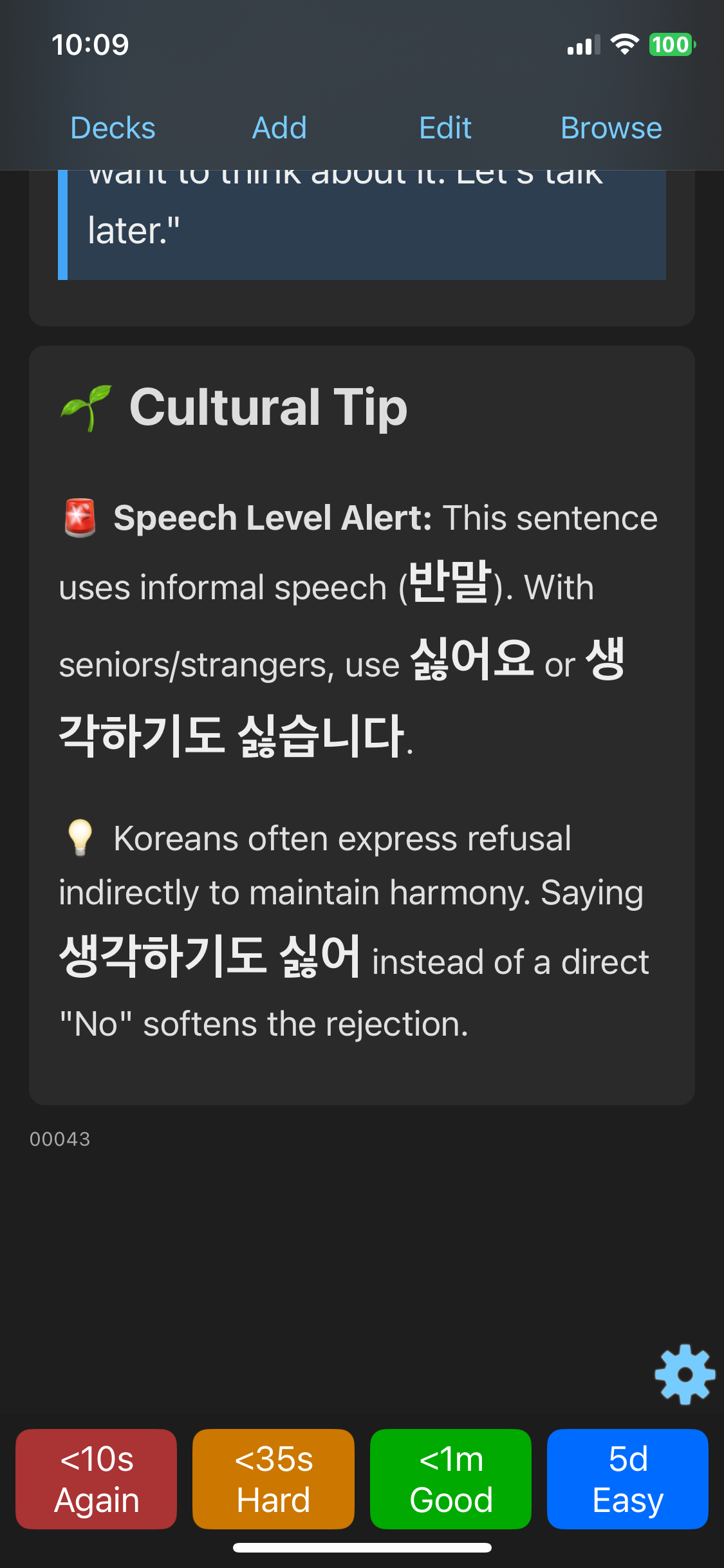
✅ Culture Tips - Know when and how to use each sentence based on the situation:
- 👵 Honorifics for elders and formal settings
- 🧑🤝🧑 Casual forms for friends and younger people
- 🗣️ Politeness levels and what's considered respectful
- 🎯 Common context for each sentence (ordering food, greeting, apologizing, etc.)
This isn't just a flashcard deck-it's a complete tool for mastering Korean sentence patterns, structure, and real-life usage. Ideal for learners who want to progress in both understanding and speaking. 🚀
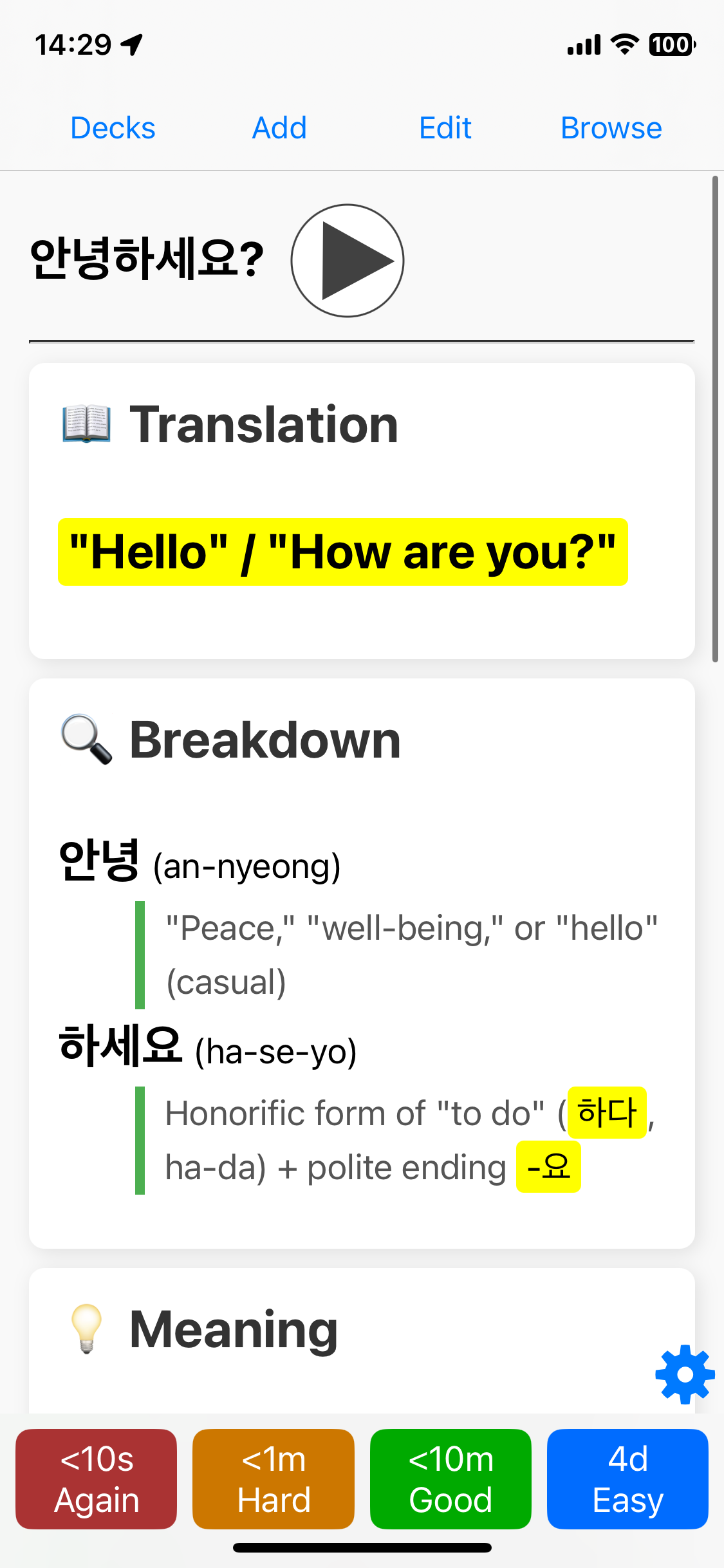
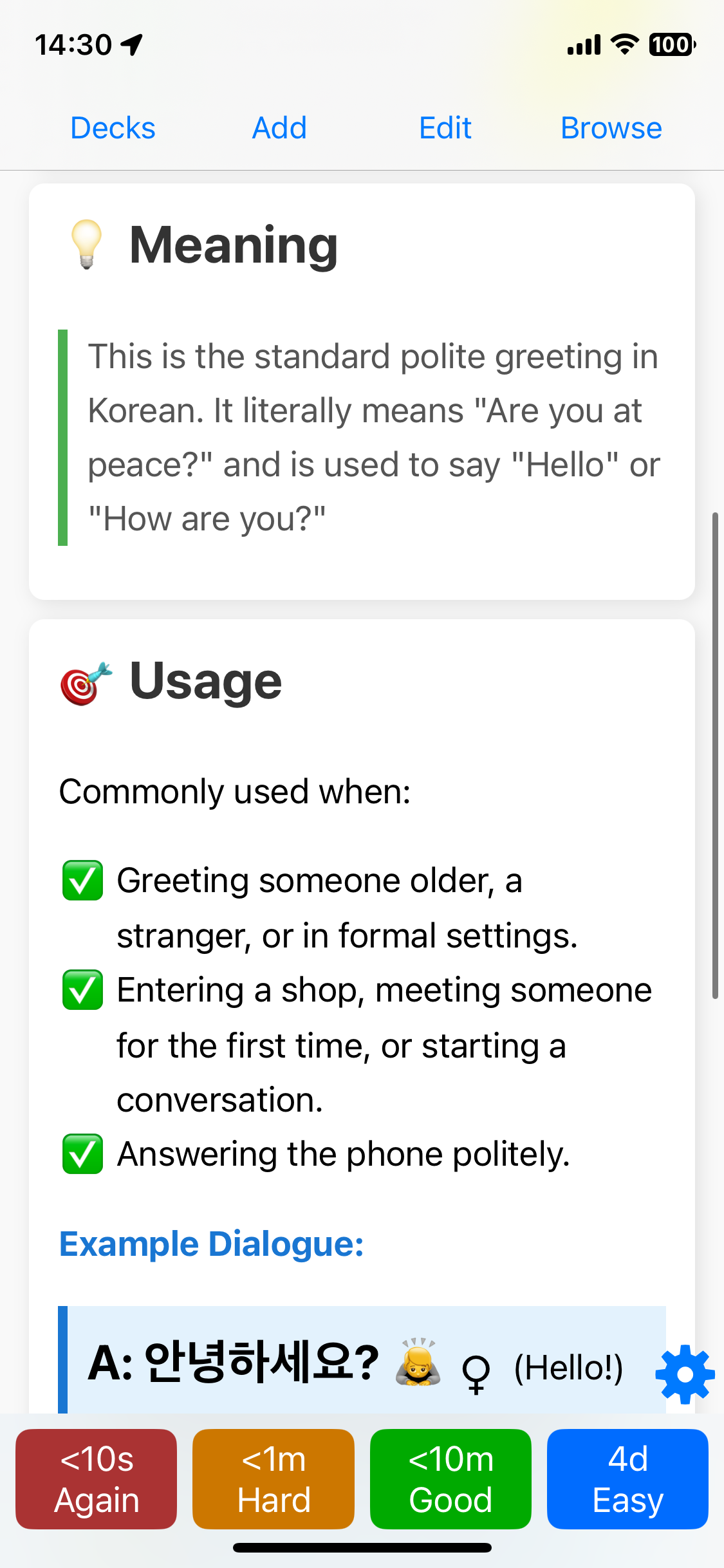
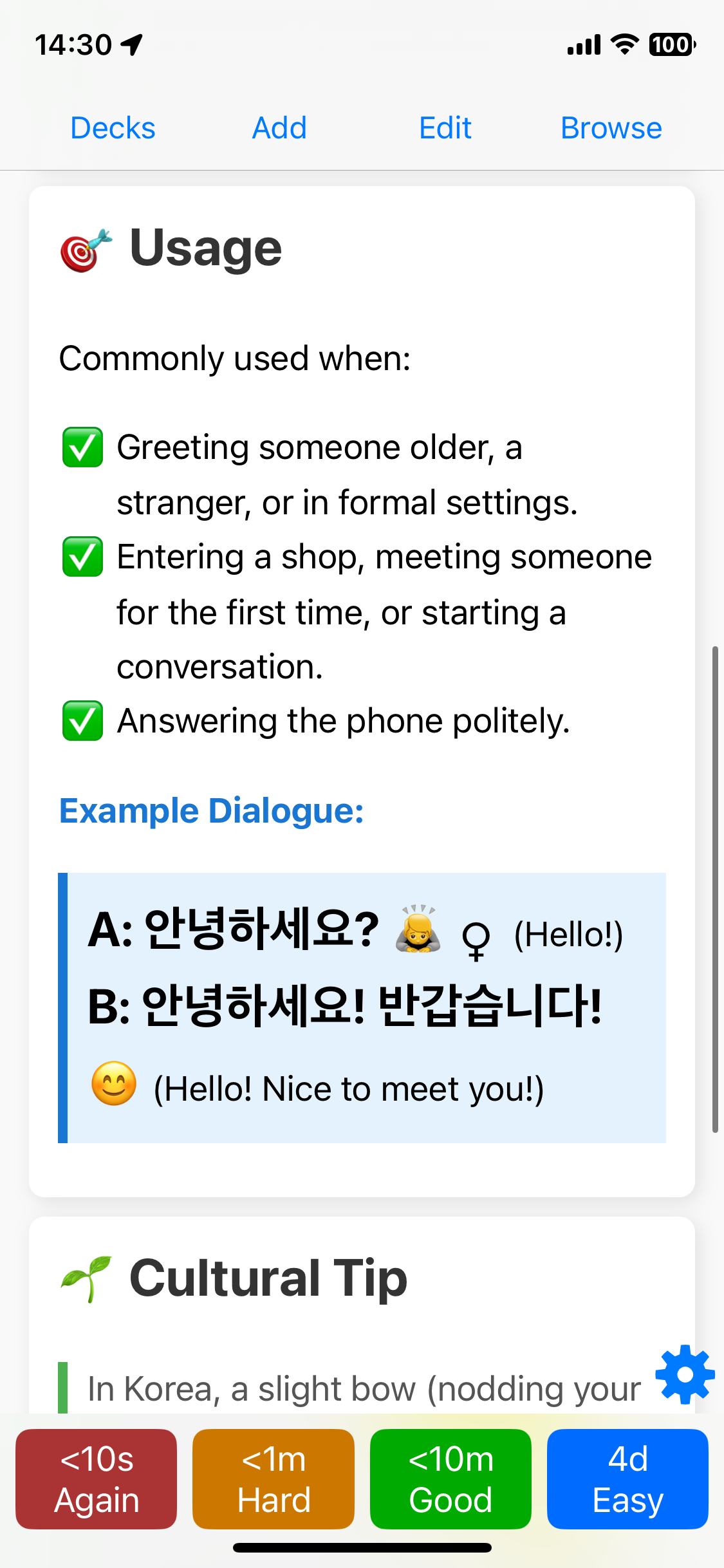
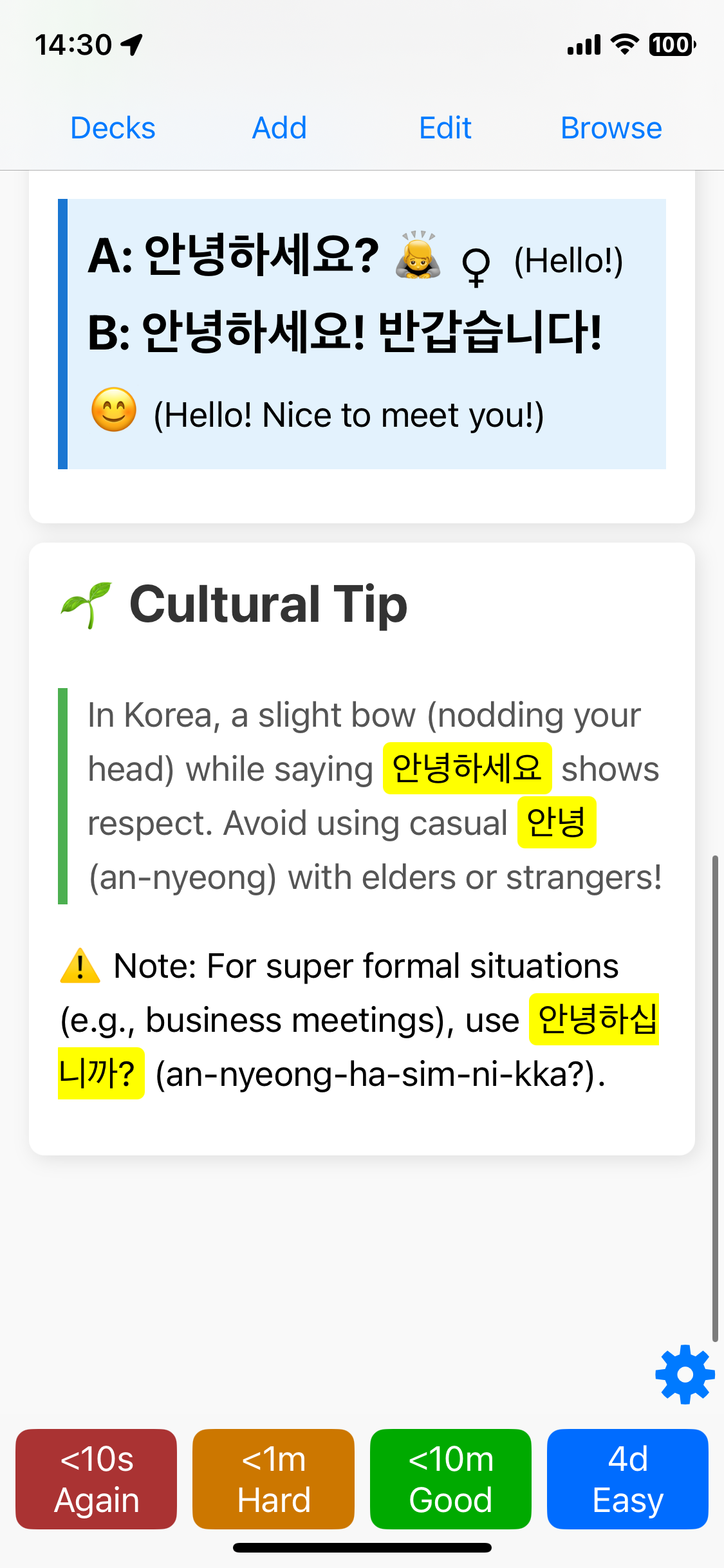
📱 How It Looks
안녕하세요?
뭘 드시겠습니까?
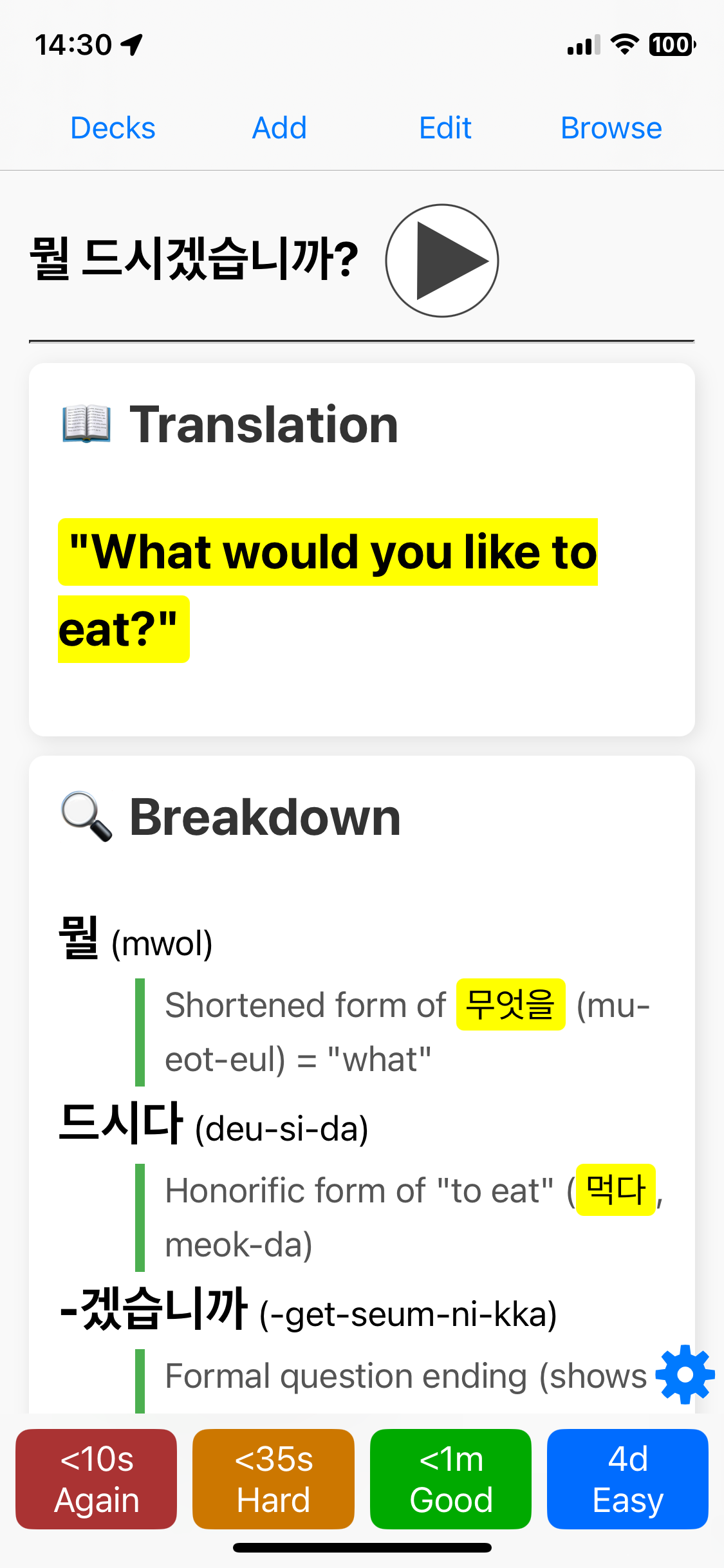
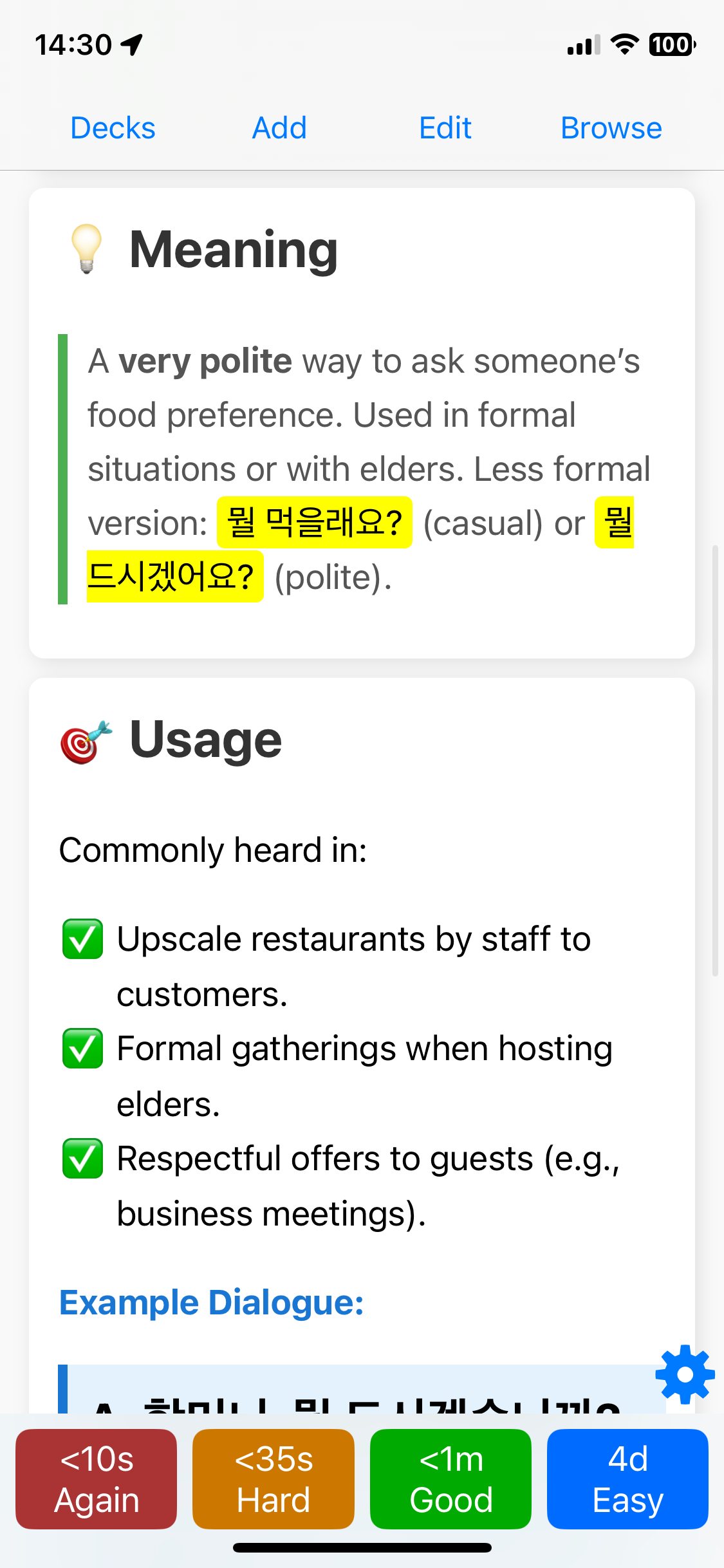
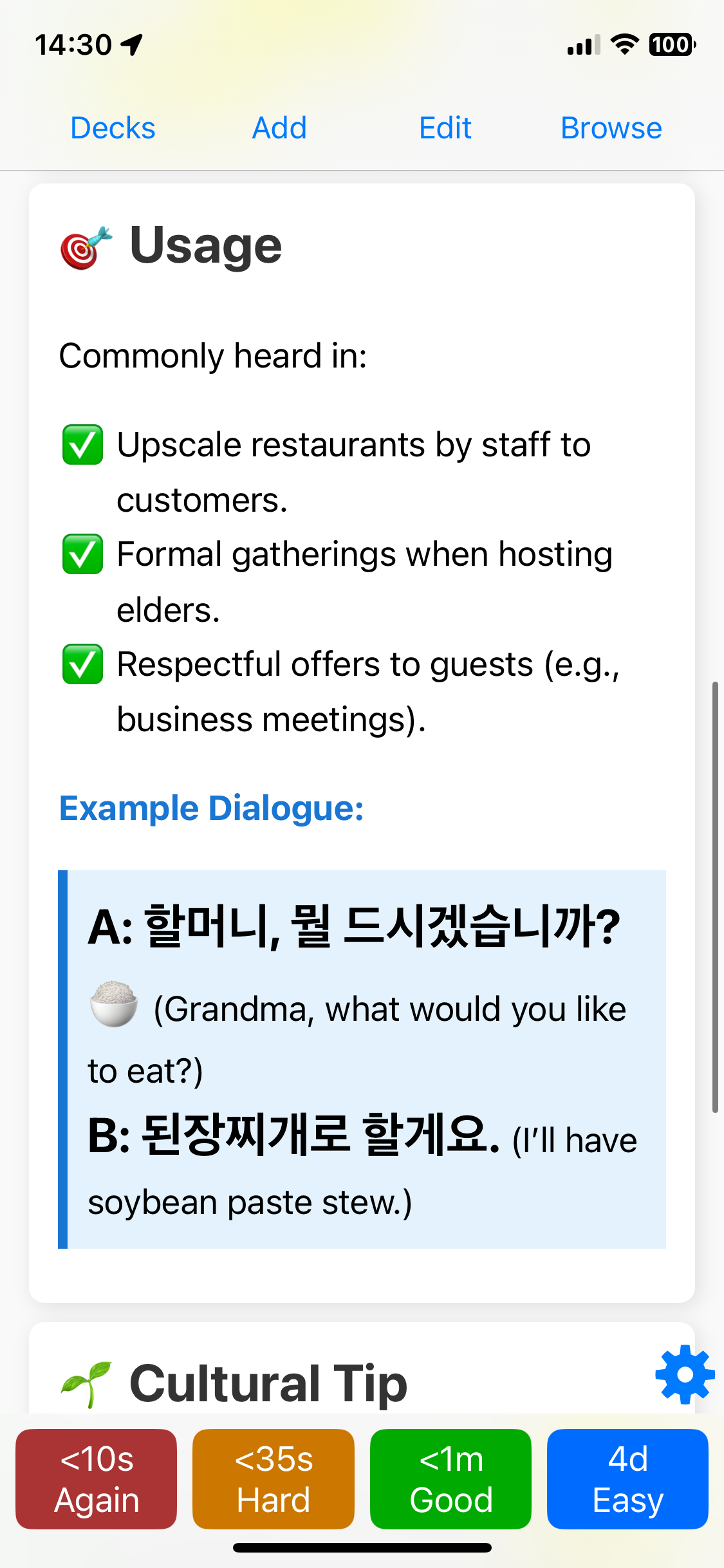
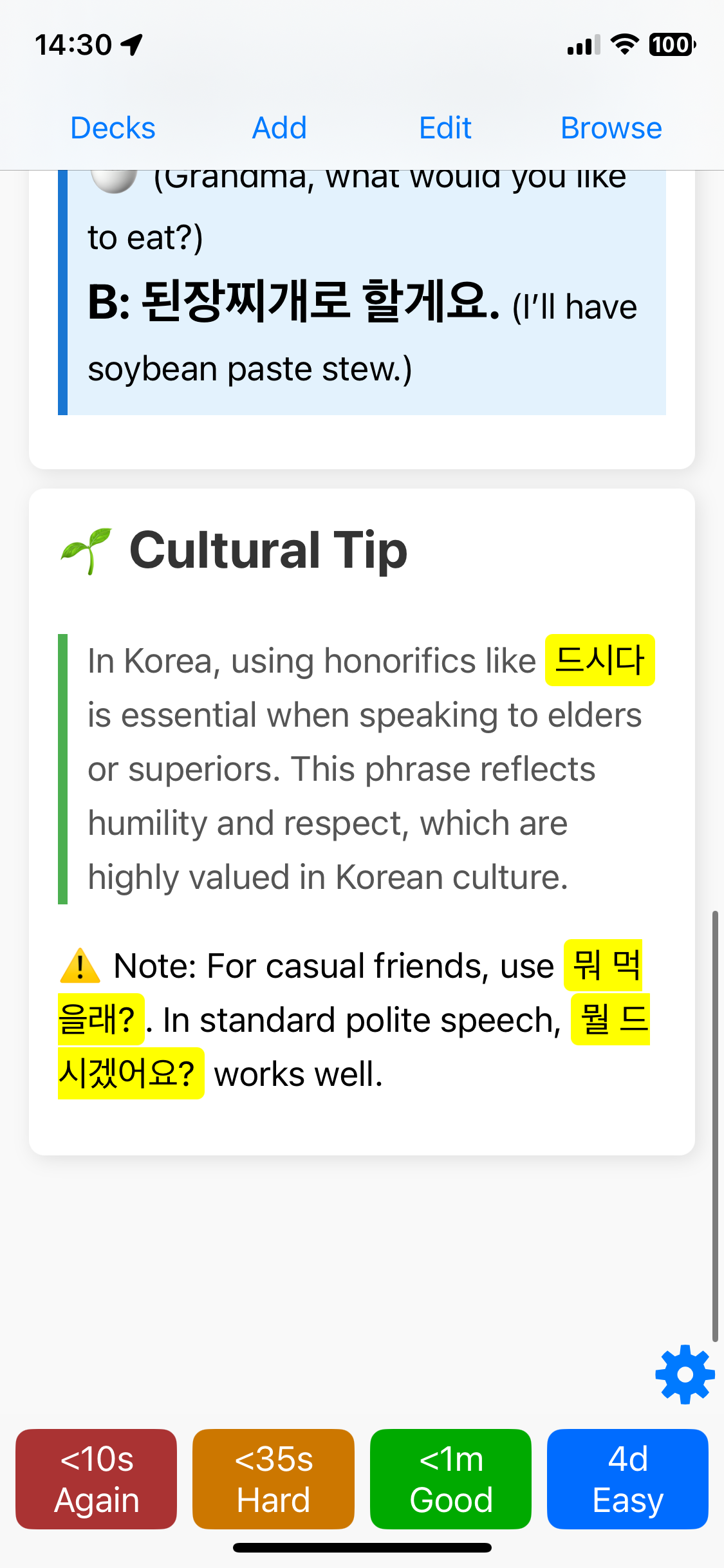
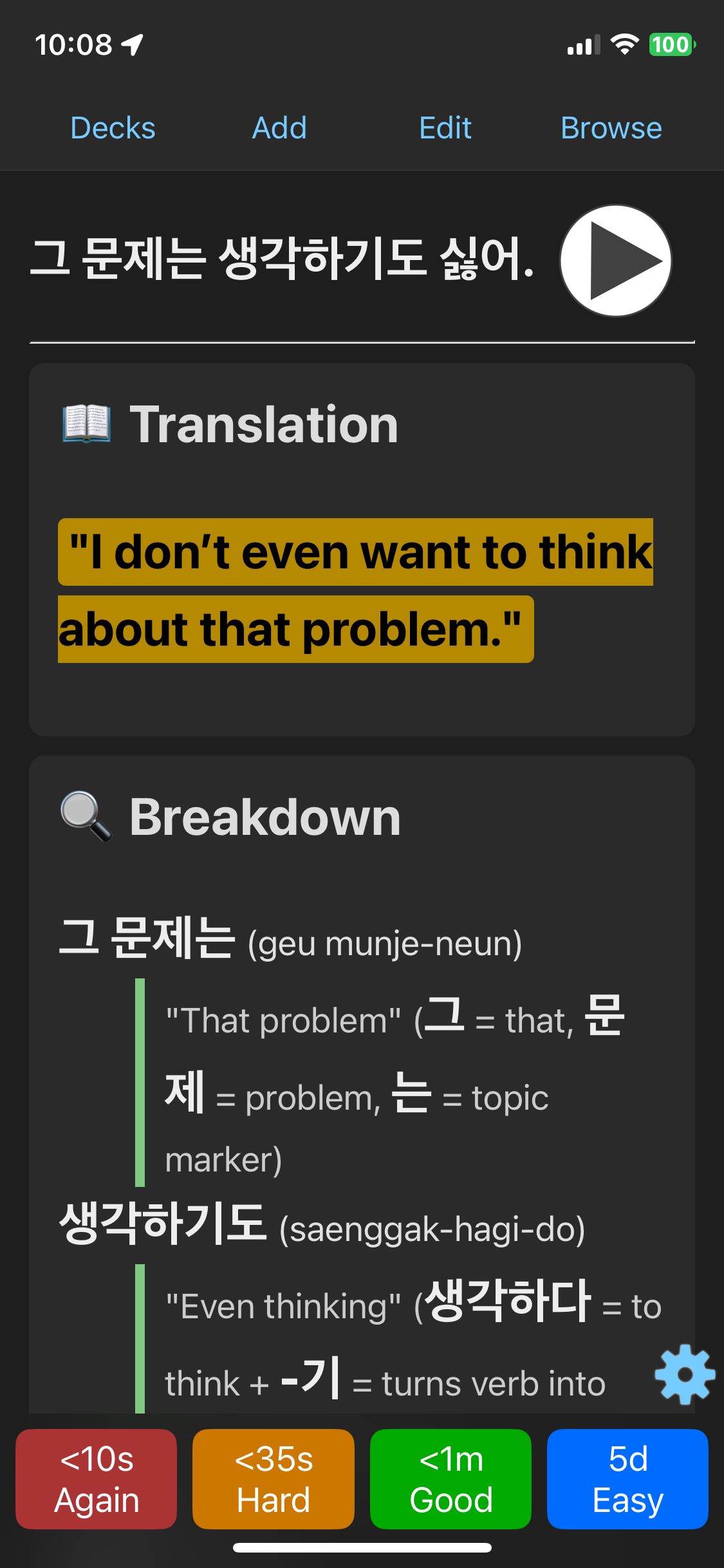
그 문제는 생각하기도 싫어.
🧠 How to Use
This deck is sorted so that each sentence contains exactly one new vocabulary word. These new words are arranged by frequency of use in the Korean language.
⚠️ Do NOT randomize the card order.
Each sentence builds on what you've already learned, helping you grow vocabulary step by step.
While it doesn't explicitly teach grammar, you can:
- Use another grammar resource to look up unfamiliar patterns (especially particles)
- Or absorb grammar intuitively through exposure and repetition
📖 Description
The audio comes from Kyubyong Park's Korean dataset. I sorted the sentences so that each one introduces just one new word based on previous ones-a "+1" learning approach.
🗳️ Feedback & Suggestions
Have ideas, feature requests, or issues to report? 📝 You're welcome to post them here: 👉 https://feedback.7000-korean-sentences.episage.com/
You can upvote, comment, or propose new suggestions to help make this deck even better for everyone.
✨ Credits
Sample Data
| id | 06045 |
| Front | 자동판매기에 넣을 잔돈 있어? |
| pronunciation | |
| Back | 📖 Translation Do you have change to put in the vending machine? 🔍 Breakdown 자동판매기 jadongpanmaegi 자동 (automatic) + 판매기 (sales machine) = "vending machine" -에 -e Location particle meaning "in/at" 넣을 neoeul Adnominal form of 넣다 (to put in). Describes the next noun: "to put in" 잔돈 jandon 잔 (leftover/small) + 돈 (money) = "coins/change" 있어? isseo? Casual question form of 있다 (to have/exist) = "Do you have...?" 💡 Meaning This question checks if someone has coins ready to use in a vending machine. It’s often asked when exact change is needed, or when preparing to buy a drink/snack. 🎯 Usage Commonly used when: Preparing to buy from a coin-only vending machine Checking if a friend has spare change Confirming payment method before using the machine Example Conversation (Casual): A: 자동판매기에 넣을 잔돈 있어? "Do you have change for the vending machine?" B: 응, 500원 동전 몇 개 있어. "Yeah, I have a few 500-won coins." 🌱 Cultural Tip ➊ Use 있으세요? (isseuseyo?) instead of 있어? when speaking to strangers/elders. ➋ Many vending machines in Korea accept T-money cards (transportation cards) as payment. ➌ Older machines might only take coins, but newer ones often accept bills up to 5,000₩. |
| id | 00549 |
| Front | 저는 스포츠 중에서 야구를 제일 좋아해요. |
| pronunciation | |
| Back | 📖 Translation "Among sports, I like baseball the most." 🔍 Breakdown 저는 jeo-neun Formal way to say "I" (저 = I, 는 = topic marker) 스포츠 중에서 seupo-cheu jung-eseo "Among sports" (중에서 = among, 스포츠 = sports) 야구를 ya-gu-reul "Baseball" (야구) + object marker (를) 제일 좋아해요 je-il jo-a-hae-yo "Like the most" (제일 = most, 좋아해요 = like) 💡 Meaning This sentence shows someone ranking their preferences. They're saying that while there are many sports, baseball is their #1 favorite. 🎯 Usage Commonly used when: Sharing your favorite sport/hobby Answering questions about preferences Comparing different activities Example Conversation: A: 어떤 스포츠를 좋아하세요? (What sports do you like?) B: 저는 스포츠 중에서 야구를 제일 좋아해요. (I like baseball the most among sports.) 🌱 Cultural Tip • Using 저는 instead of 나는 makes this polite/formal. Use this with people older than you or in formal situations. • Baseball (야구) is extremely popular in Korea! The KBO League (Korean Baseball Organization) has many passionate fans. |
| id | 06319 |
| Front | 눈이 파랗게 멍들었어요. |
| pronunciation | |
| Back | 📖 Translation "My eye is bruised and blue." 🔍 Breakdown 눈 nun The noun for "eye" 이 i Subject marker (indicates 눈 is the subject) 파랗게 parahge Adverb form of 파랗다 (parahda) meaning "blue" → "in a blue way" 멍들었어요 meongdeureosseoyo Past tense of 멍들다 (meongdeulda) → "became bruised" 💡 Meaning This sentence describes an eye injury where the skin around the eye has turned blue due to bruising. It emphasizes the visible color of the bruise. 🎯 Usage Commonly used when: Explaining a physical injury from accidents or sports Describing someone's appearance after being hurt Example Conversation: A: 눈이 왜 그렇게 빨개요? "Why are your eyes so red?" B: 어제 넘어져서 눈이 파랗게 멍들었어요. "I fell yesterday, so my eye is bruised blue." A: 괜찮아요? 병원에 가 봤어요? "Are you okay? Did you go to the hospital?" 🌱 Cultural Tip 💬 In Korea, people often share details about visible injuries to explain their condition. If speaking to elders/superiors, add ~었습니다 instead of ~었어요 for formality: "눈이 파랗게 멍들었습니다." 🩹 The word 멍 (bruise) is frequently used in daily life. You might also hear 멍이 들다 (to get a bruise) or 멍이 빠지다 (for a bruise to fade). |